
There are about 160,000 moth species worldwide, far more than butterflies. The types most people care about fall into three groups: household moths that damage clothes and pantry food (webbing clothes moth, casemaking clothes moth, Indian meal moth), garden and tree pests (spongy moth, diamondback moth), and large, showy moths like the luna, polyphemus and atlas moths. Below are 15 common and notable types with pictures, sizes and how to recognize them.
| Moth | Wingspan | Look | Group |
|---|---|---|---|
| Webbing clothes moth | About 1/2 inch | Plain golden-buff, reddish hair tuft on head | Household pest |
| Casemaking clothes moth | About 1/2 inch | Brownish with faint dark spots | Household pest |
| Indian meal moth | About 5/8 inch | Pale gray front, coppery-red outer half of wings | Pantry pest |
| Spongy (gypsy) moth | Males 1.5 in, females 2 in+ | Males brown; females white, don’t fly | Tree pest |
| Diamondback moth | About 5/8 inch | Brown, pale diamond pattern along the back | Garden pest |
| Luna moth | About 4.5 inches | Pale green, long curving tails | Giant silk moth |
| Polyphemus moth | Up to about 6 inches | Tan with large eyespots on hind wings | Giant silk moth |
| Atlas moth | Up to about 10 inches | Reddish-brown, snake-head wing tips | Giant silk moth (Asia) |
| White witch | Up to about 11 inches | Pale gray-white with dark zigzags | Largest wingspan of any moth |
| Hercules moth | Up to about 10 inches | Brown with clear windows, long tails | Giant silk moth (Australia) |
Table of Contents
Household Moths
1. Webbing clothes moth (Tineola bisselliella)
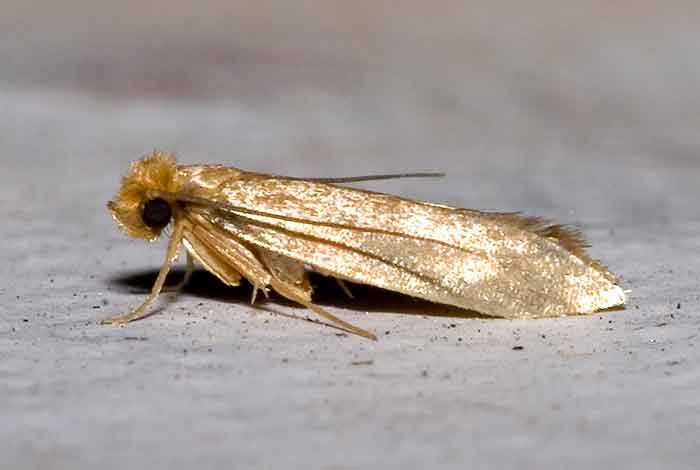
A small, plain golden-buff moth about 1/2 inch across with a tuft of reddish hair on its head. The larvae, not the adults, eat wool, silk, fur, feathers and felt, leaving holes and silken webbing. Adults avoid light and flutter rather than fly.
2. Casemaking clothes moth (Tinea pellionella)
Very similar in size to the webbing clothes moth but brownish with faint dark spots. Its larvae carry a silk case made of fibers from what they eat, so you may see tiny tubes on wool clothes and rugs.
3. Indian meal moth (Plodia interpunctella)
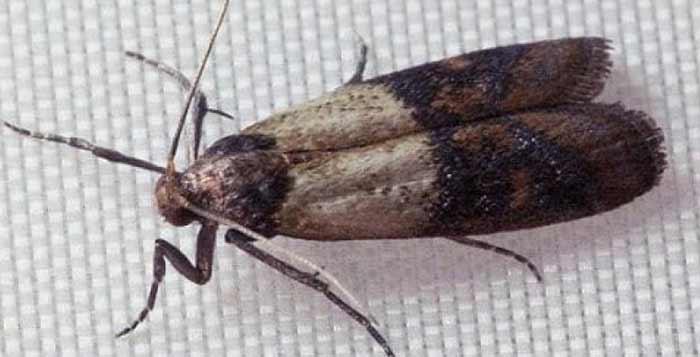
The most common pantry moth, about 5/8 inch across. The front of the wings is pale gray and the outer half coppery-red. Larvae infest flour, cereal, rice, nuts, dried fruit, bird seed and pet food, leaving webbing in the package.
Find out why these moths appear in homes in house moths and what moths eat.
Garden and Tree Pest Moths
4. Spongy moth (Lymantria dispar)
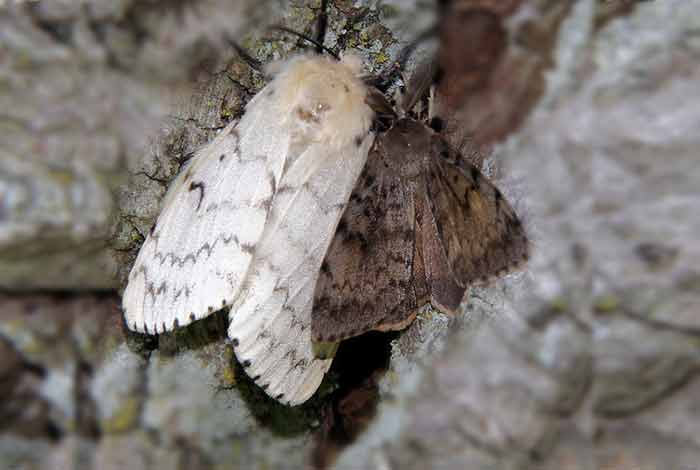
Formerly called the gypsy moth, renamed spongy moth in 2022. Males are brown and fly; females are white, heavier and can’t fly. The hairy caterpillars strip oak and other trees of leaves in outbreak years, and their hairs can irritate skin.
5. Diamondback moth (Plutella xylostella)
A small brown moth, about 5/8 inch across, with a pale diamond pattern down its back when the wings are folded. Its green caterpillars chew cabbage, broccoli, kale and other brassicas.
6. Peppered moth (Biston betularia)
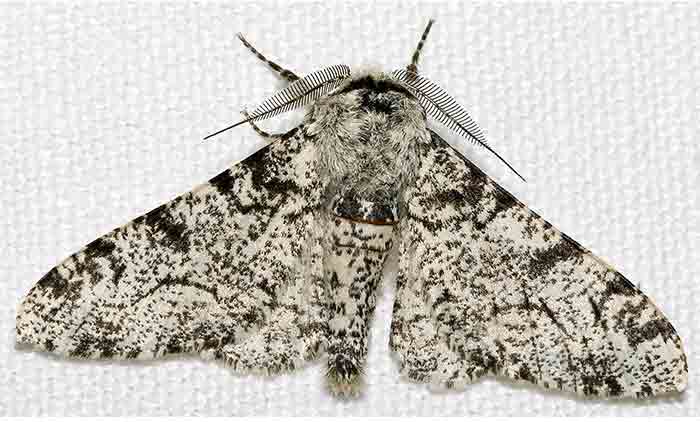
A white moth speckled with black, about 1.5 to 2.5 inches across. During England’s industrial era a dark form became common on soot-darkened trees, making it a textbook example of natural selection.
Large and Showy Moths
7. Luna moth (Actias luna)
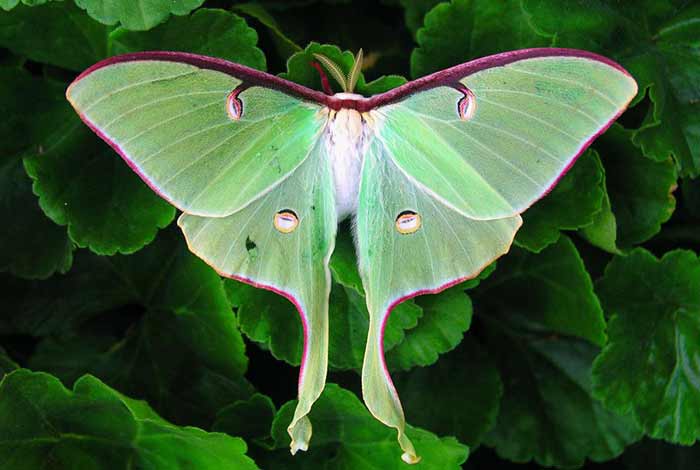
A pale green North American moth about 4.5 inches across, with eyespots and long, curving hind-wing tails. Adults have no mouths and live only about a week.
8. Polyphemus moth (Antheraea polyphemus)
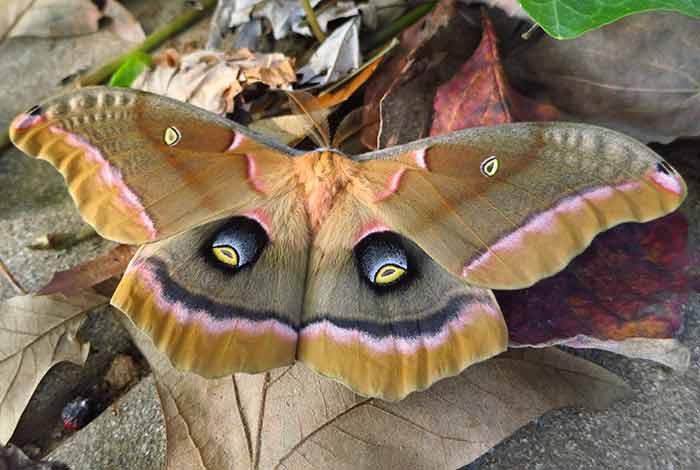
A tan to reddish-brown North American silk moth up to about 6 inches across, with large, purple-ringed eyespots on the hind wings.
9. Atlas moth (Attacus atlas)
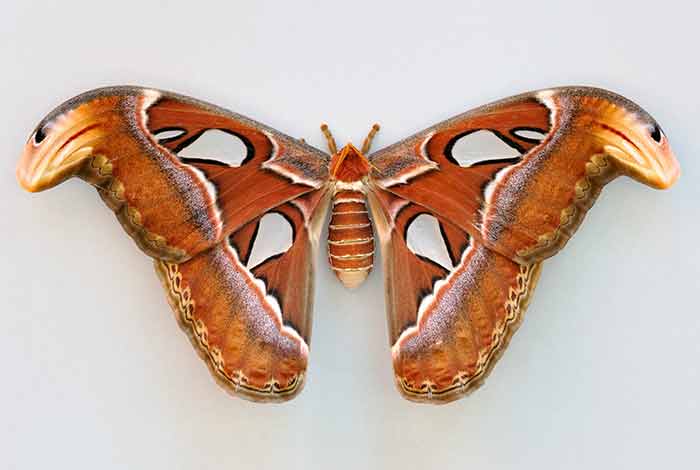
One of the largest moths, from the forests of Southeast Asia, with a wingspan up to about 10 inches. The curled wing tips look like snake heads, which may scare off predators.
10. White witch (Thysania agrippina)
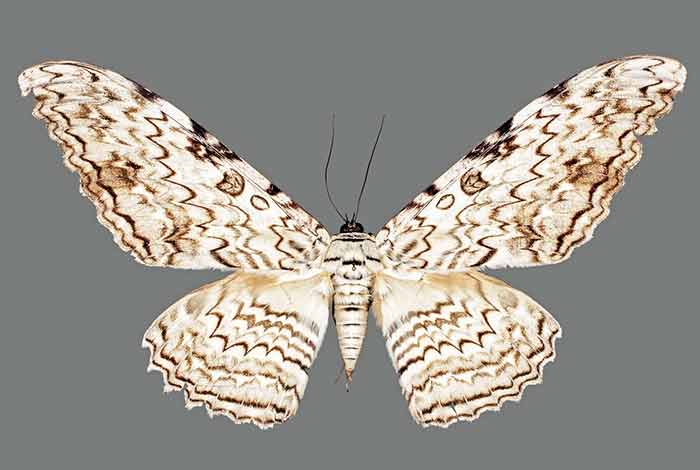
A pale, zigzag-patterned moth from Central and South America with the widest wingspan of any insect, up to about 11 inches.
11. Hercules moth (Coscinocera hercules)
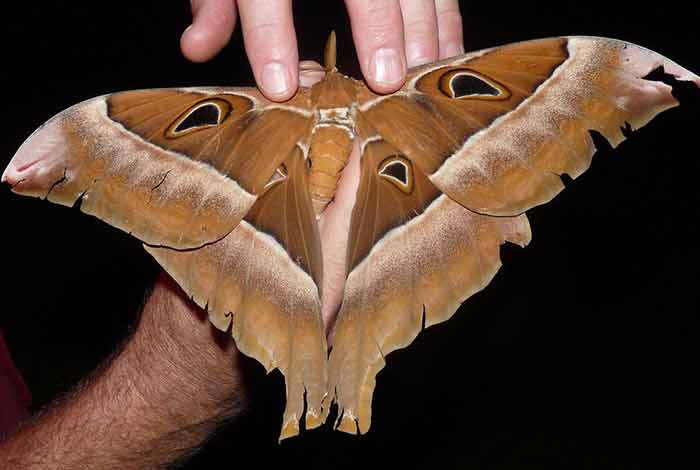
A giant brown silk moth from Australia and New Guinea, up to about 10 inches across. Males have long tails on the hind wings.
Other Well-Known Moths
12. Domestic silk moth (Bombyx mori)
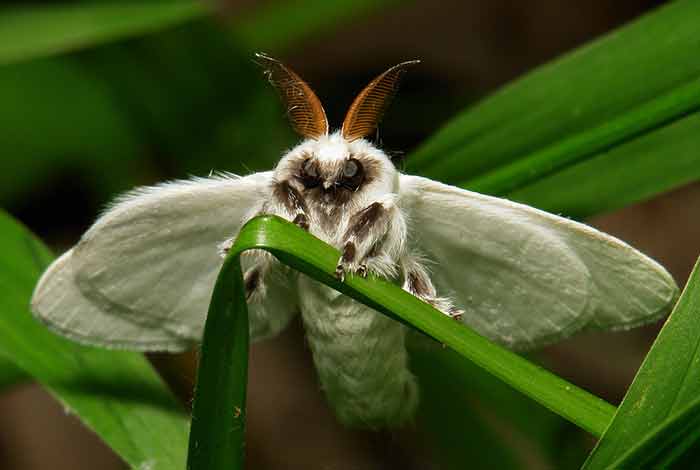
A white, furry moth that no longer exists in the wild. Its caterpillars, silkworms, spin the cocoons used to make silk. Adults can’t fly.
13. Tiger moths (Arctiinae)
A large group of stout, often boldly patterned moths. The woolly bear caterpillar grows into the Isabella tiger moth. Many warn predators with bright colors and some make ultrasonic clicks to jam bat sonar.
14. Cinnabar moth (Tyria jacobaeae)
A striking black moth with red lines and spots, about 1.5 inches across. Its black-and-yellow striped caterpillars feed on ragwort, which makes them distasteful to birds.
15. Virginian tiger moth (Spilosoma virginica)
A white tiger moth with a few black dots and yellow-orange sides on the abdomen. Its hairy caterpillar, the yellow woolly bear, feeds on garden plants.
Moths vs Butterflies
| Moths | Butterflies | |
|---|---|---|
| Antennae | Feathery or thread-like, no club | Thin with a club at the tip |
| Active | Mostly at night | Daytime |
| Resting wings | Held flat or tent-like over the body | Folded upright over the back |
| Body | Stout and furry | Slender and smooth |
| Pupa | Often a silk cocoon | A bare chrysalis |
More on moths: moth life cycle, are moths dangerous and how to get rid of moths.
Stop household moths
- Clothes moth pheromone traps to catch males and monitor
- Pantry moth traps for kitchens and cupboards
- Airtight food containers to keep pantry moths out
- Cedar blocks for closets and drawers
As an Amazon Associate, Pestbugs earns from qualifying purchases.
FAQs
Scientists have described about 160,000 moth species worldwide, far more than the roughly 17,500 butterfly species.
The moths found in houses are mainly the webbing clothes moth and casemaking clothes moth, which damage fabrics, and the Indian meal moth, which infests pantry food.
The white witch has the widest wingspan of any moth, up to about 11 inches. The atlas and Hercules moths have the largest overall wing area.
Most moths are harmless. Clothes and pantry moth larvae damage fabric and food, some caterpillars have irritating hairs, and a few, like the spongy moth, damage trees.
Moths usually have feathery or thread-like antennae, fly at night and rest with wings flat, while butterflies have clubbed antennae, fly by day and fold their wings upright.