
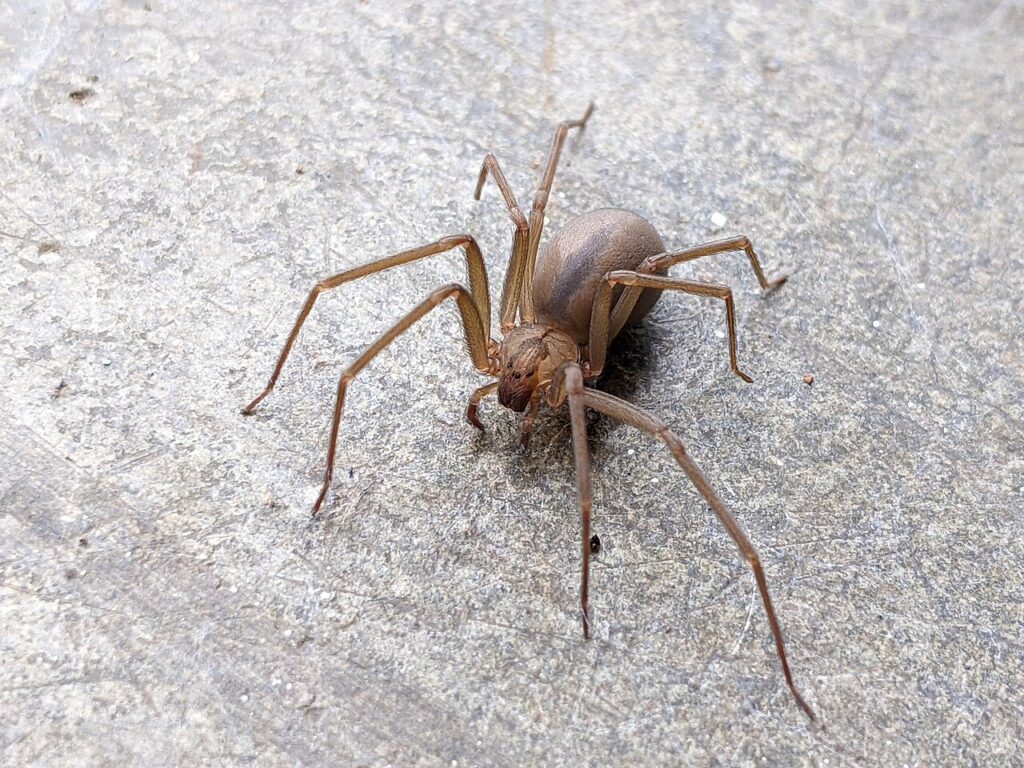
A brown recluse is a tan-to-dark-brown spider with a darker, violin-shaped mark on its back, a body about 3/8 inch long, and a leg span about the size of a U.S. quarter. The surest sign is its six eyes, set in three pairs; most spiders have eight. Brown recluses live mainly in 16 central and southern states, hide in quiet indoor spaces, and bite only when trapped against skin. Most bites heal on their own, but a small share cause a slow-healing sore that needs a doctor.
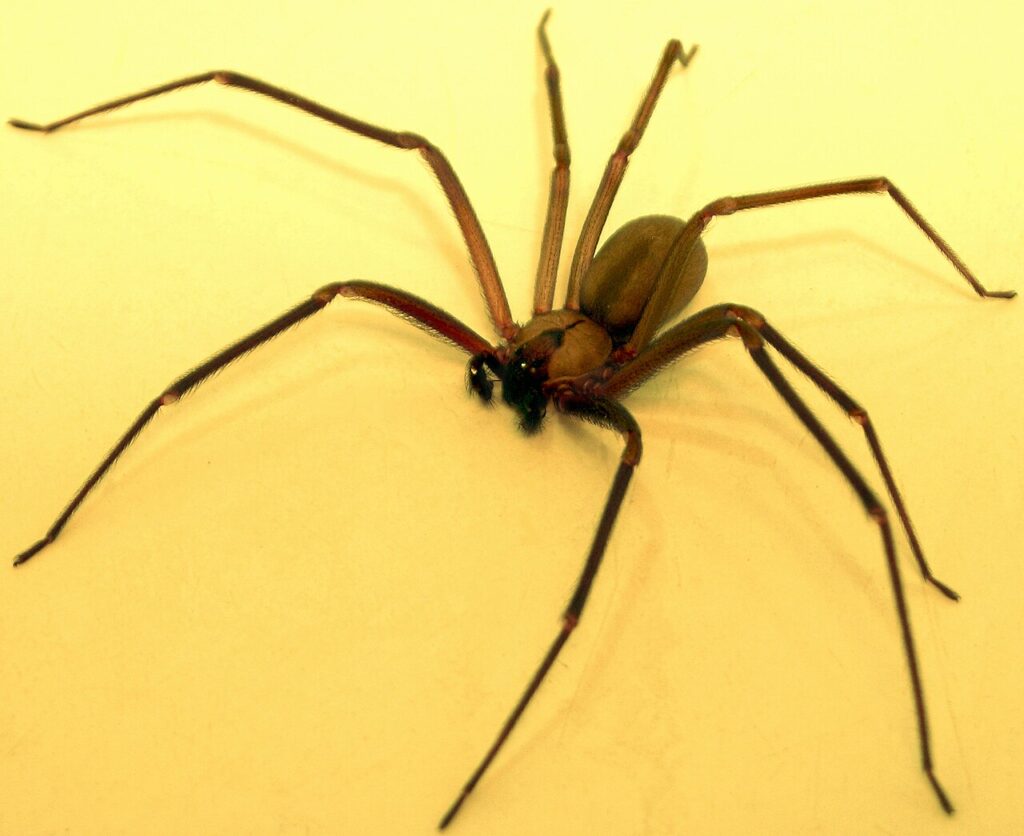
Table of Contents
How to Identify a Brown Recluse
- Eyes: six eyes in three pairs, arranged in a half circle. This is the most reliable sign, and a hand lens helps.
- Violin mark: a dark fiddle shape on the back with the neck pointing toward the abdomen. It can be faint on young spiders and isn’t enough on its own.
- Color: tan to dark brown, with the legs and abdomen a single plain color. No stripes, bands or mottling.
- Legs: long and thin, covered in fine hair, with no obvious spines.
- Size: body about 3/8 to 1/2 inch; with legs spread, about the size of a quarter.
Spiders with striped or banded legs, a patterned abdomen, thick spiny legs or eight eyes are not brown recluses.
Brown recluse look-alikes
| Spider | How to tell it apart |
|---|---|
| Wolf spider | Eight eyes, two of them large; hairy body with stripes; banded or spiny legs. See wolf spider identification. |
| Cellar spider | Tiny body with extremely long, thin legs; hangs in a loose web. |
| American house spider | Round, patterned abdomen; hangs in a tangled cobweb. |
| Grass spider | Striped body and two finger-like spinnerets at the rear; builds a funnel web outdoors. |
| Spitting and woodlouse spiders | Also six-eyed, but spitting spiders have black spots and woodlouse spiders have reddish legs and a pale abdomen. |
Many brown spiders get mistaken for recluses. In areas outside the recluse range, a “brown recluse” almost always turns out to be something else. Our guide to common house spiders covers the most likely suspects.
Where Brown Recluses Live
Brown recluses are established in Alabama, Arkansas, Georgia, Illinois, Indiana, Iowa, Kansas, Kentucky, Louisiana, Mississippi, Missouri, Nebraska, Ohio, Oklahoma, Tennessee and Texas. They are most concentrated in Missouri and Arkansas. Single spiders turn up in other states, usually carried in boxes or furniture, but no established population exists in places like California.
Where they hide in a house
- Cardboard boxes, stored clothing and shoes, and piles of clutter
- Closets, attics, basements, crawl spaces and garages
- Behind and under beds and furniture, and behind baseboards
- Wall voids, ductwork and registers, and above suspended ceilings
Outdoors, they live in sheds, barns, woodpiles, debris, and under rocks, tarps, plywood, and tires.
Brown Recluse Behavior
Brown recluses are not aggressive. They hunt at night, don’t catch prey in webs, and spend the day tucked into dark, undisturbed spaces. Males and older young wander more, which is why they end up in shoes, clothes, and bedding. Their fangs are too small to bite through clothing, so bites happen when a spider is pressed against bare skin.
A brown recluse can survive months without food, and a heavily infested house can hold hundreds or thousands of them with very few bites. One Kansas home yielded 2,055 recluses in six months, yet the family reported only one bite in about a decade of living there.
Brown Recluse Bite
A bite often goes unnoticed at first or feels like a mild sting. Redness, swelling and tenderness usually show up 3 to 8 hours later, and pain can build over that time.
- About 90% of bites: no reaction or a small red bump that heals on its own.
- About 10%: the center turns pale, then dark blue or purple, with a red ring around it. It can become an open sore that grows for days or weeks and leaves a scar.
- Under 1%: symptoms throughout the body, such as fever, chills, rash, dizziness, or vomiting. Children, older adults and people in poor health are at higher risk.
Most bites heal within about three weeks. Deaths are rare.
Not every sore is a spider bite
Doctors misdiagnose “spider bites” often. Bacterial skin infections such as MRSA, along with shingles, Lyme disease, diabetic ulcers, poison ivy and bites from other insects, can all look like a recluse bite. In one study of patients who came in for a “spider bite,” 29% had MRSA. Catching the spider is the only way to be sure.
First aid and when to see a doctor
- Wash the bite with soap and water.
- Hold a cold, wet cloth or wrapped ice on it, and raise the limb.
- Don’t try to cut out or suck out venom.
- If you can safely do so, catch the spider in a jar, even if it is crushed.
Get medical care if you believe a recluse bit you, or if the bite becomes severely painful, the wound grows or darkens, red streaks spread from it, or you develop fever, chills or trouble breathing. Keep tetanus shots up to date.
How to Get Rid of Brown Recluse Spiders
- Sticky traps: set flat glue cards along baseboards, in corners, behind furniture and in closets. Check them weekly to see whether numbers are dropping.
- Cut clutter: recluses need hiding places, so clear piles of boxes, papers and clothes.
- Swap cardboard for plastic: store items in sealed plastic bins or bags.
- Protect clothes and shoes: keep them off the floor, and shake them out before wearing anything you’ve stored.
- Make the bed safe: pull beds away from walls, remove bed skirts, and keep blankets from touching the floor.
- Seal gaps: door sweeps and caulk around doors, vents, utility lines, siding and eaves keep new spiders out.
- Clear the outside: move firewood and debris away from the foundation.
Insecticide dusts in wall voids and cracks, plus sprays in hiding spots, can help, but chemicals alone work poorly against recluses. Foggers seldom work. For an established infestation, hire a pest control professional and maintain traps and clutter control.
Brown recluse control supplies
- Flat glue traps for monitoring and catching
- Sealed plastic storage bins to replace cardboard boxes
- Door sweeps to close gaps under exterior doors
- Hand lens to count a spider’s eyes
As an Amazon Associate, Pestbugs earns from qualifying purchases.
FAQs
Check the eyes: a brown recluse has six eyes arranged in three pairs, where most spiders have eight. It is tan to dark brown with a darker violin-shaped mark on its back, and its legs and abdomen are one plain color with no stripes, bands or spines.
They are established in 16 central and southern states, from Nebraska and Ohio south to Texas and Georgia, and are most common in Missouri and Arkansas. Spiders found elsewhere usually arrived in boxes or stored goods.
No. They hide during the day and bite only when pressed against skin, such as when someone rolls onto one in bed or puts on a shoe or glove it is hiding in.
Most bites cause no reaction or a small red bump that heals on its own. Some turn red and swollen 3 to 8 hours later, and about 1 in 10 develop a pale or dark center that can become an open sore over days.
Yes, if you think a recluse bit you or the wound is growing, very painful, spreading red streaks, or comes with fever. Bring the spider if you can catch it, even crushed, so it can be identified.
Set flat sticky traps along walls and behind furniture, cut clutter, store items in sealed plastic bins, seal gaps around doors and vents, and pull beds away from walls. Heavy infestations need a professional, since sprays alone work poorly.
Sources
- University of Kentucky Entomology: Brown Recluse Spider
- UC IPM Pest Notes: Recluse Spiders
- Penn State Extension: Brown Recluse Spiders
- Nebraska Extension: Brown Recluse Spiders: Misidentified, Misdiagnosed and Misunderstood
- Mayo Clinic: Spider Bites
- CDC/NIOSH: Venomous Spiders
Facts in this guide are checked against the sources above and reviewed when they change. See how we research in our editorial policy.