
Most spiders found in U.S. homes are harmless: the American house spider in cobwebs, long-legged cellar spiders in basements, yellow sac spiders on walls and ceilings, and wandering wolf, jumping and grass spiders. Only two groups need real caution: the brown recluse and the widow spiders. Use the table below to match what you see, then check the guide for that spider.
Table of Contents
Common House Spiders at a Glance
| Spider | Size (legs spread) | Look | Web | Danger |
|---|---|---|---|---|
| American house spider | About a nickel | Brown and tan with dark patterns, round abdomen | Tangled cobweb in corners and windows | Harmless |
| Cellar spider | About a half-dollar | Tiny gray or tan body, very long thin legs | Loose, messy web in basements and garages | Harmless |
| Yellow sac spider | Small, about 1/4 inch body | Pale yellow to greenish | No web; hides in a silk sac in wall and ceiling corners | Painful but minor bite |
| Wolf spider | Eraser to silver dollar | Hairy, brown or gray with stripes | No web; runs on floors | Harmless; bites only if grabbed |
| Jumping spider | About a dime | Compact and fuzzy, huge front eyes | No web; hops on walls and windowsills | Harmless |
| Grass spider | About a quarter | Brown with stripes, two finger-like spinnerets | Sheet web with a funnel, mostly outdoors | Harmless |
| Giant house / hobo spider | Up to 4 inches (giant house) | Brown with chevron pattern on abdomen | Sheet web with a funnel in basements and window wells | Not considered dangerous |
| Brown recluse | About a quarter | Plain tan, violin mark, six eyes | No web for catching prey; hides in boxes and clothes | Medically significant |
| Black widow | About 1 1/2 inches | Glossy black, red hourglass | Tough, tangled web in sheds, garages, woodpiles | Medically significant |
American House Spider
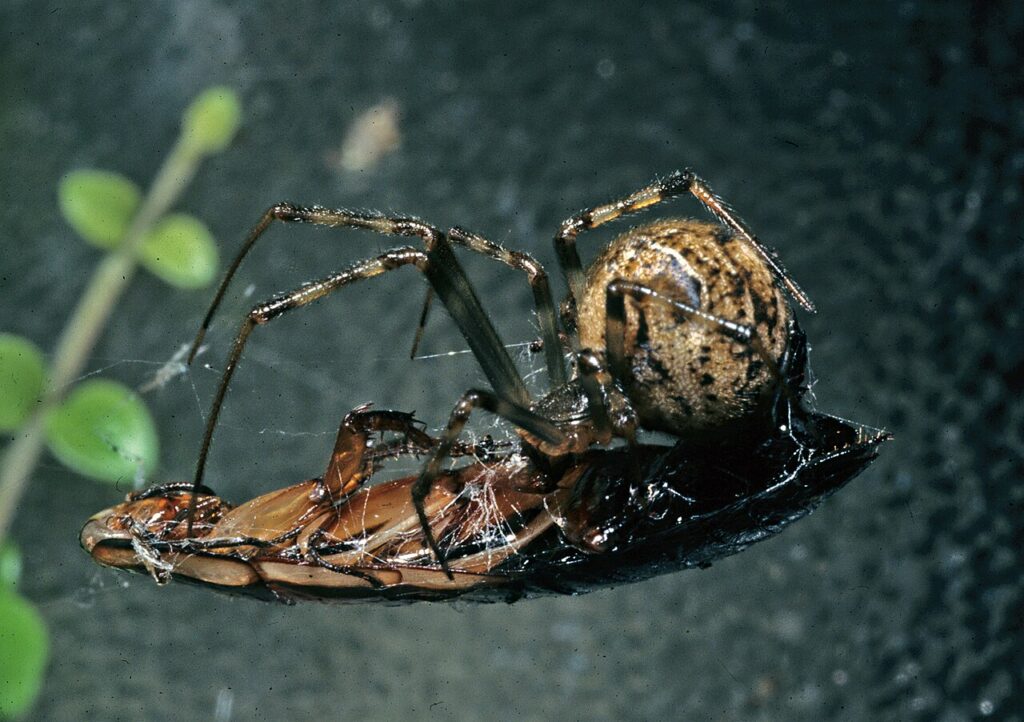
The American house spider (Parasteatoda tepidariorum) is a small brown-and-tan spider with a round, mottled abdomen; females are about 1/4 inch long. It builds a messy, sticky cobweb in room corners, windows, basements and crawl spaces and hangs upside down in it. Its light brown, pear-shaped egg sacs hang in the web. It is harmless and seldom bites; the webs are the only nuisance.
Cellar Spiders (Daddy Long Legs)
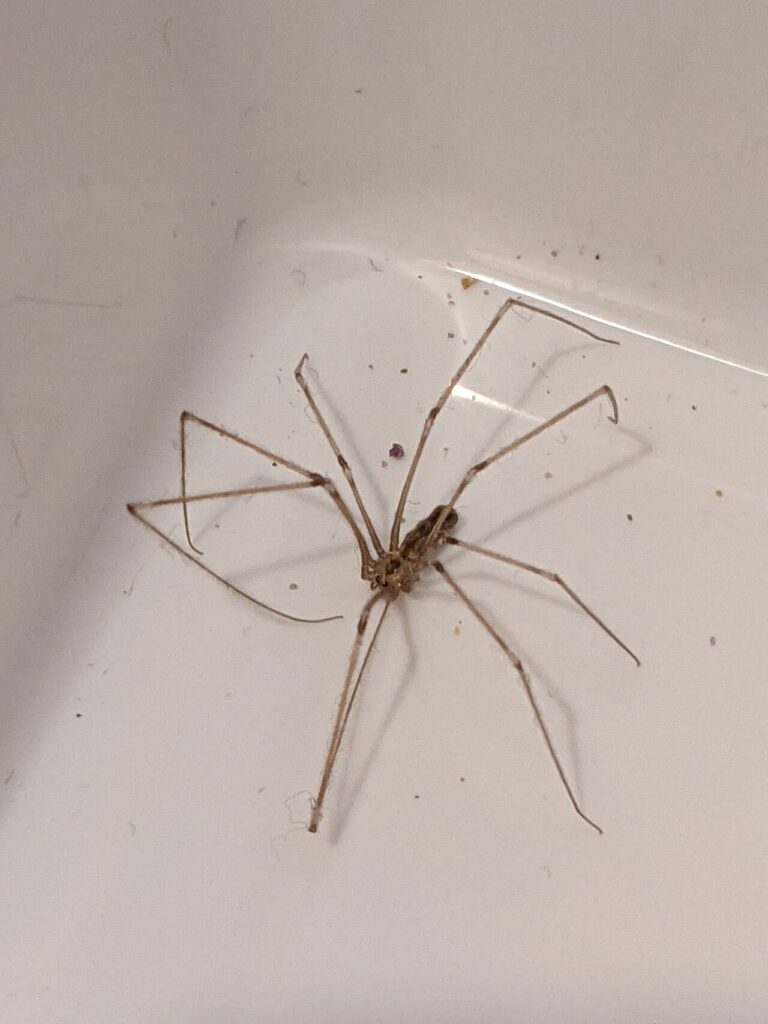
Cellar spiders have a small gray or tan body, about 1/4 to 1/3 inch long, and very long, thin legs. They build loose, tangled webs in dark basements, crawl spaces and garages, and shake rapidly in the web when disturbed. In most cases their fangs are too short to pierce skin, and they eat other spiders, including brown recluses.
Cellar spiders are often called daddy long legs, as are harvestmen. Harvestmen are not spiders: they have one fused, oval body, only two eyes, no venom glands and no silk.
Yellow Sac Spiders
Yellow sac spiders are pale yellow to greenish, with a slightly darker stripe on top of the abdomen, and measure about 1/5 to 2/5 inch long. They don’t catch prey in webs. They rest during the day in a small silk sac in corners of walls and ceilings and roam at night. They are suspected of causing many spider bites in homes. The bite is painful but short-lived and not medically significant.
Wolf Spiders
Wolf spiders are hairy brown or gray hunters with stripes, a body 1/4 inch to over 1 inch long, and two large forward-facing eyes. They build no webs and run across floors, especially in fall and in newly built neighborhoods. Females carry their egg sac, then their young, on their backs. See our full wolf spider identification guide and the guide to wolf spider bites.
Jumping Spiders
Jumping spiders are small, compact and fuzzy, with two huge front eyes, and often have bright or iridescent markings. They hunt in daylight on walls, windowsills and siding, stalk their prey and pounce. They sometimes wander inside and stay for the winter. They may nip if handled roughly, but bites are mild. More in our jumping spider guide.
Grass Spiders and Funnel Weavers
Grass spiders are brown and striped, with two long spinnerets that stick out from the rear like fingers. They build a flat sheet web with a funnel at one side, easiest to spot in lawns and shrubs when dew covers it. Some wander indoors in late summer and fall. They are harmless, though people often mistake them for brown recluses.
Hobo Spiders and Giant House Spiders
These funnel-web builders live mainly in the Pacific Northwest and the western U.S. The hobo spider is brown with yellowish chevrons on a gray abdomen and no leg bands; females are about 3/8 to 5/8 inch long. The giant house spider is bigger, with a body up to an inch and a leg span up to 4 inches, and often turns up in sinks, tubs, garages and basements.
The hobo spider was once blamed for flesh-damaging bites, but there is no significant scientific evidence for that, and the CDC does not list it as a dangerous species. The giant house spider’s bite is not known to harm people.
The Two Spiders to Watch For
Brown recluse: plain tan to brown, with a dark violin mark and six eyes, living in 16 central and southern states. It hides in boxes, closets, clothing and shoes. See brown recluse identification and bites.
Black widow: glossy black with a red hourglass underneath, building tough, tangled webs in garages, sheds and woodpiles. See black widow identification and bites.
Why Spiders Come Into Your House
- Cooler fall weather sends some species looking for shelter.
- Gaps under doors, around windows, vents and pipes let them walk in.
- Firewood, debris and plants touching the house give them a bridge.
- Plenty of insects indoors means plenty of food, and more spiders.
Most house spiders are useful. They eat flies, mosquitoes, moths and other insects, and control is rarely needed beyond keeping webs down.
How to Get Rid of House Spiders
- Vacuum webs, spiders and egg sacs. Each sac can hold hundreds of young, so removing sacs matters most.
- Set sticky traps along baseboards, behind furniture and in garages.
- Seal entry points with caulk and door sweeps, and repair screens.
- Cut clutter and store boxes sealed and off the floor.
- Change outdoor lights to yellow or sodium vapor bulbs, which draw fewer insects.
- Move firewood and debris away from the foundation and trim plants back from walls.
Sprays only give short-term control unless the housekeeping steps come first, and foggers seldom work on spiders.
House spider control supplies
- Sticky traps for baseboards and garages
- Cordless vacuum for webs and egg sacs
- Yellow bug-light bulbs for porches and doors
- Door sweeps and weatherstripping to close gaps
As an Amazon Associate, Pestbugs earns from qualifying purchases.
FAQs
In much of the U.S., the American house spider is the one you see most: a small brown spider with a round, patterned abdomen that hangs upside down in a tangled cobweb in corners and windows. Cellar spiders are a close second in basements.
Almost never. Most house spiders can’t harm people, and many have fangs too small to pierce skin. Only the brown recluse and the widow spiders are medically significant in the U.S., and both live in quiet, out-of-the-way spots.
Spiders follow food and shelter. Cooler fall weather drives some indoors, and gaps around doors, firewood and plants against the house give them a way in. A home with plenty of insects supports more spiders.
Two different creatures share the name. Cellar spiders are true spiders with two body parts and long thin legs. Harvestmen are not spiders at all: they have one oval body, two eyes, no venom and no silk.
Vacuum webs, spiders and egg sacs, set sticky traps along baseboards, seal cracks and add door sweeps, cut clutter, and switch outdoor lights to yellow bulbs. Sprays only help briefly unless you also remove what attracts spiders.
Sources
- UC IPM Pest Notes: Spiders
- Colorado State University Extension: Spiders in the Home
- University of Kentucky Entomology: Urban Spider Chart
- University of Kentucky Entomology: Eliminating Spiders Around Homes and Buildings
- Utah State University Extension: Hobo Spider
- Washington State University: Giant House Spider
- Missouri Department of Conservation: Daddy Longlegs (Harvestmen)
Facts in this guide are checked against the sources above and reviewed when they change. See how we research in our editorial policy.
Related guides
- Brown Recluse Spider: Pictures, Identification, Bite & Removal
- Black Widow Spider: Pictures, Identification, Bite & Removal
- Wolf Spider: Pictures, Identification, Size & Facts
- Jumping Spiders: Pictures, Identification, Bites & Facts
- Yellow Garden Spider (Writing Spider): Pictures, Web & Facts
- Banana Spider: Size, Bite, Poisonous, Web & Pictures