
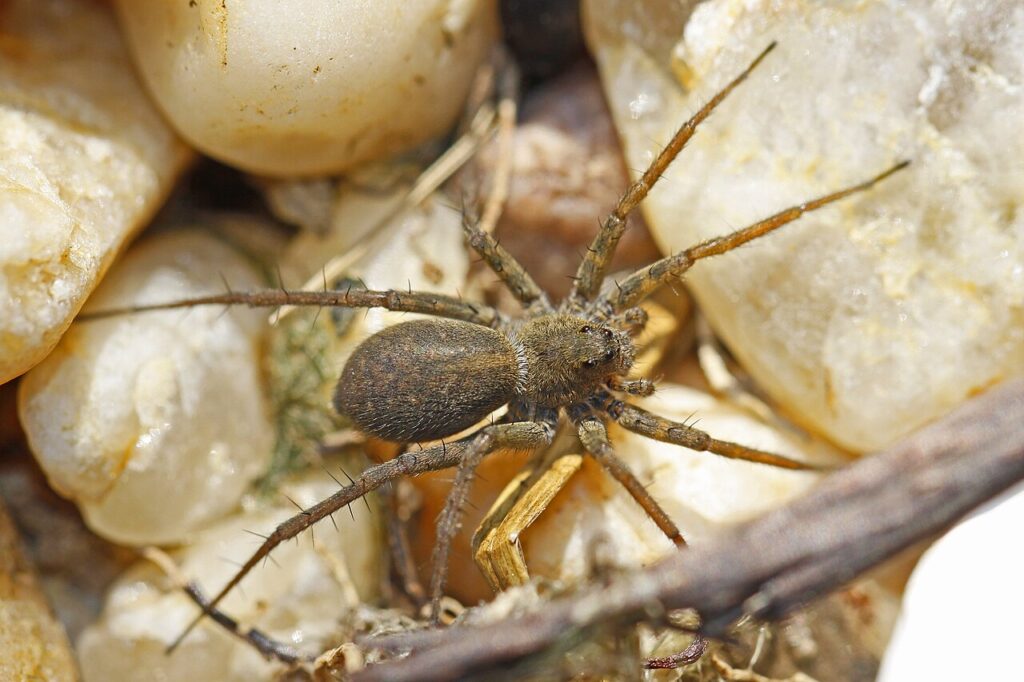
A wolf spider is a fast, hairy hunting spider, brown, gray, or black with darker stripes, and about 1/4 to 1 inch long; the largest species reach about 2 inches. The surest way to identify one is the eyes: a bottom row of four small eyes, two large eyes above them facing forward, and two more on top of the head. Wolf spiders don’t build webs. They run down insects on the ground, mostly at night, and aren’t dangerous to people.
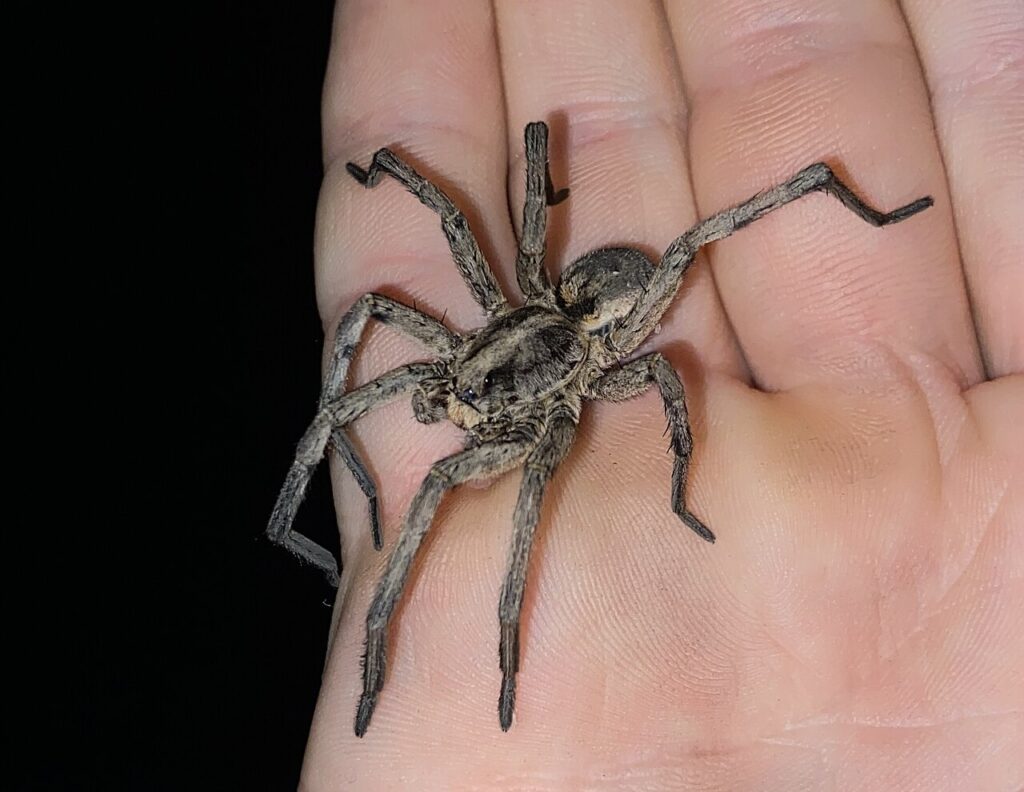
Table of Contents
How to Identify a Wolf Spider
- Size: body 1/4 to 1 inch long, not counting legs. Females are usually bigger than males.
- Color: gray, brown, black or tan, often with dark brown or black stripes running down the back. The colors blend in with soil and leaf litter.
- Body: hairy, with a long, oval abdomen.
- Legs: long, thick and spiny, built for running.
- Eyes: eight eyes in three rows, with two large eyes facing forward.
- Behavior: runs fast across floors, ground and patios, and freezes when you get close.
Wolf spider eyes and eyeshine
Look at the face. A row of four small eyes sits low on the front of the head. Above it are two large eyes facing forward, and two more sit farther back on top of the head. These big eyes give wolf spiders good night vision.
A reflective layer behind the eyes makes them shine at night. Hold a flashlight beside your own eyes and sweep a lawn or the edge of the woods after dark, and wolf spider eyes glow back like tiny green or white sparks.
Female Wolf Spiders: Egg Sacs and Babies
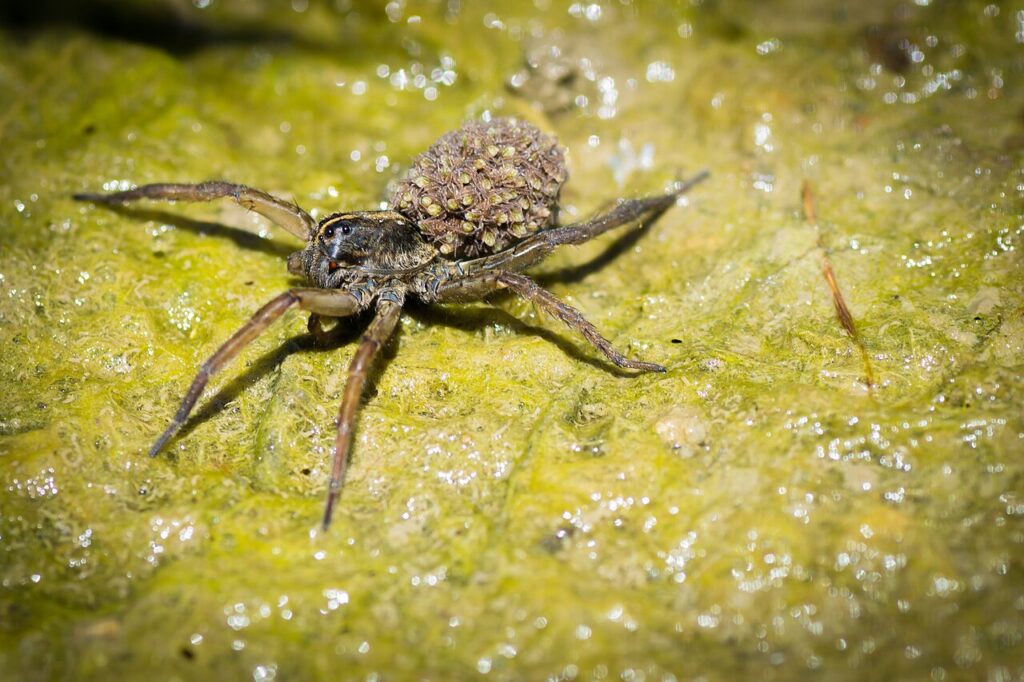
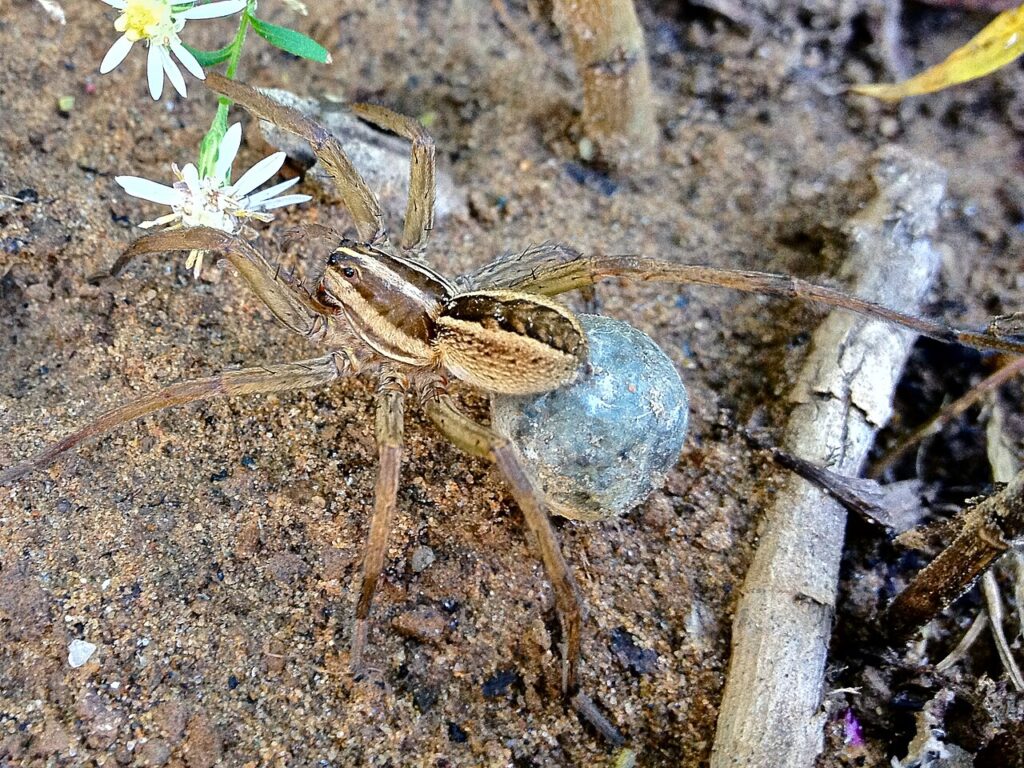
Female wolf spiders carry their eggs. The female attaches a round, pea-sized silk egg sac to the spinnerets at the tip of her abdomen and drags it everywhere. A sac can hold more than 100 eggs. She guards it closely and searches frantically if it comes loose.
When the spiderlings are ready, she opens the sac and they climb onto her back, sometimes several layers deep. They ride there for one to two weeks or more before scattering to live on their own. A spider that looks fuzzy or lumpy on top may be a mother covered in babies.
Wolf Spider Look-Alikes
| Spider | How to tell it from a wolf spider |
|---|---|
| Brown recluse | Six eyes in three pairs instead of eight; a dark violin-shaped mark behind the head; plain legs without bands. Hides in undisturbed spots indoors. See wolf spider vs brown recluse. |
| Grass spider | Builds a flat sheet web with a funnel at one side and waits in the funnel. Wolf spiders build no web. |
| Fishing and nursery web spiders | Carry the egg sac in their jaws, not on the spinnerets. Often found near water and can run across its surface. |
| Tarantula | Much larger and heavier, with a thick, furry body. |
| Jumping spider | Also has two big forward-facing eyes, but is small and compact and moves in quick jumps. |
Where Wolf Spiders Live
Nearly 250 species of wolf spider live in North America north of Mexico, in almost every land habitat: lawns, fields, woodland leaf litter, stream banks, sand and gravel bars, and shorelines. Some dig burrows or hide in cavities under rocks and logs. Others roam with no fixed home.
- Carolina wolf spider (Hogna carolinensis): one of the largest in North America, gray-brown and common in fields and yards.
- Thin-legged wolf spiders (Pardosa): small, dark spiders common in damp areas near water.
Why Wolf Spiders Come Inside
Wolf spiders most often show up indoors in fall, when they look for a warm place to spend the winter. They slip in under doors, around windows, and through garages, then hide behind doors, along baseboards, in closets, under furniture, among houseplants, and in basements.
Wolf spiders live alone and build no webs, so one in the house is usually a single hunter that wandered in. Seeing many suggests easy entry points and plenty of insects to eat.
Are Wolf Spiders Dangerous?
No. Wolf spiders are venomous, like nearly all spiders, but their venom targets insects and is weak against people. They run from people and bite only when picked up, stepped on or trapped against skin. A bite stings and swells like a bee sting and fades in a few days. A female guarding an egg sac is the most likely to bite.
For pictures, symptoms, and what to do, including bites on dogs and cats, see our guide to wolf spider bites.
How to Get Rid of Wolf Spiders in the House
- Catch and release: place a cup or jar over the spider, slide a card underneath and carry it outside.
- Vacuum: vacuum spiders you find in corners and under furniture, then empty the canister outdoors.
- Sticky traps: set flat glue traps along baseboards, in corners, behind furniture and near doors. Wolf spiders roam the floor, so traps catch them well.
- Seal gaps: add door sweeps and weatherstripping, repair window screens, and caulk gaps around vents, pipes, wires and the bottom edge of siding.
- Clear the perimeter: move firewood, lumber, leaf piles and debris away from the foundation.
- Cut clutter: boxes and piles in basements, closets and garages give spiders places to hide.
Sprays do less against wolf spiders than against web-building spiders, since wolf spiders roam instead of sitting in one spot. Total-release foggers (“bug bombs”) seldom work on spiders. For a heavy problem, a light dusting of insecticide in cracks and wall voids, or a professional treatment, is an option.
Wolf Spider Facts
- Diet: crickets, flies, cockroaches, grasshoppers and other insects, which makes them useful in gardens.
- Hunting: mostly at night, sensing vibrations and seeing well in low light.
- Predators: lizards, mice, shrews, turkeys and many other birds.
- Lifespan: some species live nearly two years.
Keep wolf spiders out
- Flat sticky traps for baseboards and garages
- Door sweeps and weatherstripping to close gaps
- Spider catcher for no-touch catch and release
- Headlamp for spotting eyeshine at night
As an Amazon Associate, Pestbugs earns from qualifying purchases.
FAQs
A wolf spider is a hairy brown, gray or black spider, usually with darker stripes on its back, a body 1/4 to 1 inch long and thick, sturdy legs. The surest sign is its eyes: four small eyes in a bottom row, two large forward-facing eyes above them, and two more on top of the head.
Wolf spiders are venomous, not poisonous, and their venom is weak against people. They bite only when handled or trapped, and in healthy adults a bite causes local pain, redness and swelling that fade within a few days.
Wolf spiders wander indoors in fall looking for a warm place to spend the winter, usually through gaps under doors, around windows and in garages. One indoors is normally a lone hunter that came in from outside, not a nest.
Most are 1/4 to 1 inch long. The largest species, such as the Carolina wolf spider, reach about 2 inches. Females are usually larger than males.
No. Wolf spiders hunt on the ground, either chasing prey or waiting still for it to come close. Some live in burrows or under rocks and logs, and some have no fixed home.
Some wolf spiders live nearly two years. Females carry their egg sac, then their spiderlings, before the young disperse.
Sources
- Missouri Department of Conservation: Wolf Spiders
- University of Minnesota Extension: Wolf Spiders
- Clemson Home & Garden Information Center: Wolf Spiders
- Oklahoma State University Extension: Wolf Spiders
- University of Kentucky Entomology: Brown Recluse Spider (spider control indoors)
Facts in this guide are checked against the sources above and reviewed when they change. See how we research in our editorial policy.