
Jumping spiders are small, compact, fuzzy spiders, usually under 1/2 inch long, with two huge eyes at the front of the head. They hunt in daylight by stalking insects and pouncing on them, without a web. The two species you see most in the U.S. are the bold jumping spider, black with white spots and shiny green jaws, and the black-and-white striped zebra jumping spider. Jumping spiders are harmless to people and rarely bite.
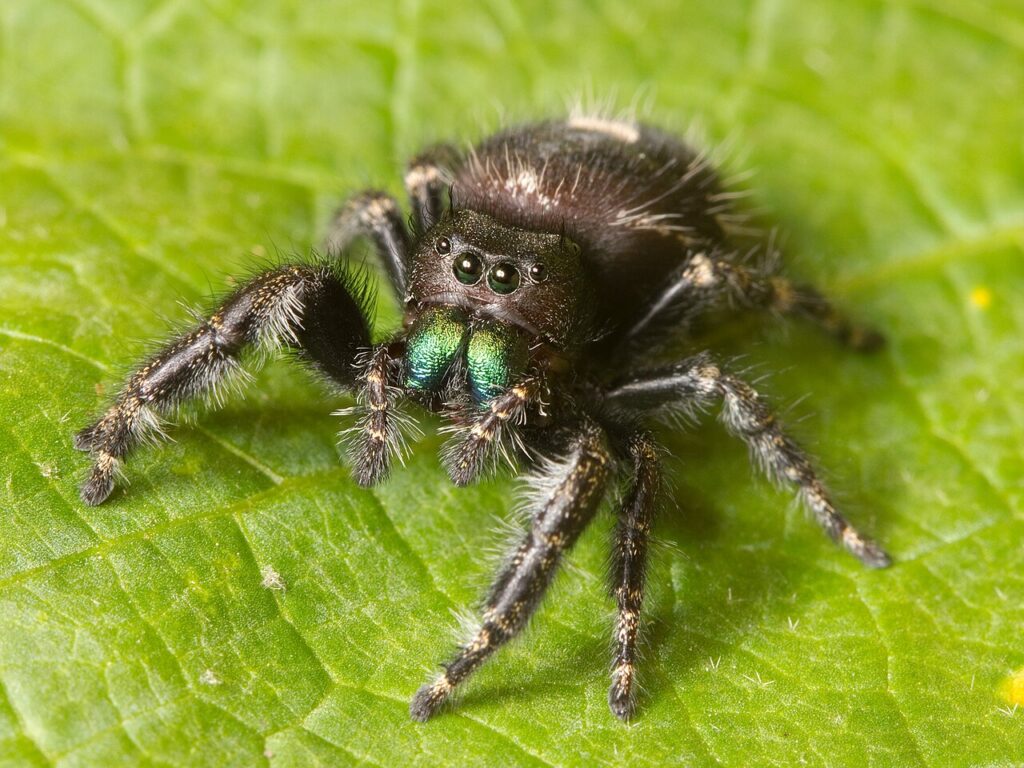
Table of Contents
How to Identify a Jumping Spider
- Size: usually under 1/2 inch; with legs spread, about the size of a dime.
- Body: compact and often hairy, with a large, boxy front section and short, sturdy legs.
- Eyes: eight eyes, with four in a row across the flat front of the face. The middle two are huge and face forward, like headlights.
- Color: often bright or metallic, especially the jaws, which can be red, white or iridescent green. Males are usually the most colorful.
- Movement: jerky, stop-start walking, with sudden hops.
Common Jumping Spiders in the U.S.
Bold jumping spider (Phidippus audax)
The bold jumper is fuzzy and usually black, with a white, orange or reddish spot in the middle of the abdomen and smaller spots around it. Its jaws shine iridescent green or blue. Females are about 1/4 to 3/4 inch long; males are usually under 1/2 inch. Young ones often have orange spots that turn white as they mature. Look for it on milkweed and other broad-leaved plants, tree trunks, fence posts, and the siding of houses and barns across most of the U.S. and southeastern Canada.
Its black color and red or orange markings sometimes make it look like a black widow. Widows are smooth and glossy, hang in tangled webs, and have long, thin legs; bold jumpers are fuzzy, short-legged, and hop.
Zebra jumping spider (Salticus scenicus)
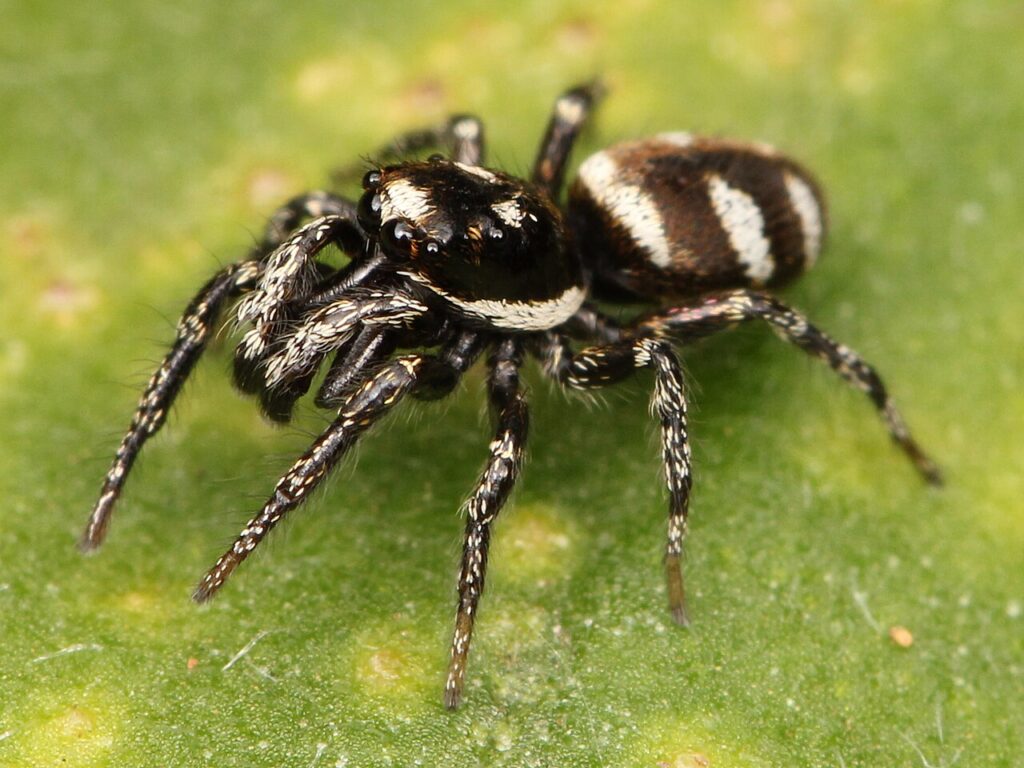
The zebra jumper is about 1/4 inch long, dark brown to black with white stripes. Males have large, dark jaws that stick forward. It came from Europe and Asia and now lives across most of the U.S. and southern Canada, on fences, walls, bushes and buildings. It is common on sunny windowsills in spring and summer and often tucks its silk retreat into cracks in boards.
Jumping Spider Vision
Jumping spiders have the sharpest eyesight of any spider. The two big front eyes give them sharp, three-dimensional vision for judging distance before a jump, and the other six eyes cover nearly all the way around them. Their lenses can’t move, but the retinas inside can, so the spider can follow you with its gaze. That is why many people feel a jumping spider is watching them.
How Jumping Spiders Hunt
Jumping spiders hunt in the daytime. They spot prey, creep closer, then leap onto it from about 10 to 40 times their body length away. Before jumping, they fix a silk safety line to the surface, which catches them if they miss. They eat insects and other spiders up to about their own size, including flies, mosquitoes, leafhoppers, and stink bugs.
They don’t build webs to catch food. Silk goes into the dragline and into small, cocoon-like retreats where they hide at night, molt, lay eggs and spend the winter.
More Than 6,000 Species
Jumping spiders make up the largest spider family, with more than 6,000 known species on every continent except Antarctica. About 300 live in the U.S., ranging from tiny brown species to bright, iridescent ones.
Do Jumping Spiders Bite?
Rarely. Jumping spiders are curious rather than aggressive and bite only when crushed, squeezed or handled roughly. A bite from a larger species feels sharp but fades within minutes, and at worst leaves a welt like a mosquito bite. No treatment is needed beyond washing the spot.
Jumping Spiders in the House
Jumping spiders wander indoors through cracks around the foundation and gaps in door and window screens, especially as the weather cools or when males roam in search of mates. They prefer sunny windowsills and walls. A single jumping spider indoors is a visitor, not an infestation.
- Move it outside: cover the spider with a jar, slide a card underneath, and release it in the garden.
- Vacuum if you’d rather not handle it.
- Seal gaps around windows, doors and the foundation, and repair torn screens.
- Cut clutter near windows and doors.
Pesticides aren’t recommended for jumping spiders. Outdoors they help control garden pests.
Spider-friendly removal
- Spider catcher for no-touch catch and release
- Window screen repair kit to close gaps
- Clip-on macro lens for close-up photos of jumping spiders
As an Amazon Associate, Pestbugs earns from qualifying purchases.
FAQs
No. Jumping spiders bite only when squeezed or handled roughly, and their bites range from nothing to a small welt like a mosquito bite that fades quickly. They are considered harmless and beneficial.
Jumping spiders can leap about 10 to 40 times their own body length. They attach a silk safety line before jumping, so they can climb back if they miss.
Jumping spiders have the sharpest eyesight of any spider. Their two large front eyes give them depth perception, and they can move their retinas to track movement, so they often turn to watch people.
No. They hunt by stalking and pouncing. They use silk only for a safety dragline and for small silk retreats where they hide, molt, lay eggs and spend the winter.
A black, fuzzy spider with a white or orange spot on its back and shiny green or blue jaws is the bold jumping spider, one of the most common jumping spiders in the U.S.
There is no need. Catch it under a jar and release it outside, where it eats flies, mosquitoes and garden pests.
Sources
- Missouri Department of Conservation: Bold Jumper
- Penn State Extension: Zebra Jumper
- UC Davis Bohart Museum of Entomology: Jumping Spiders
- University of Arkansas Arthropod Museum: Bold Jumping Spider
- UF/IFAS: Regal Jumping Spider
- Oregon State University Extension: Insects and Spiders Seek Winter Shelter Indoors
Facts in this guide are checked against the sources above and reviewed when they change. See how we research in our editorial policy.