
The yellow garden spider (Argiope aurantia) is a large black-and-yellow orb-weaver; the female’s body is about 3/4 to 1 inch long, with black legs banded yellow-orange and a silvery head. It hangs head-down in the center of a round web about 2 feet across, marked with a thick white zigzag down the middle. It is also called the writing spider, zipper spider, corn spider and black and yellow garden spider. It is not dangerous, rarely bites and eats many garden pests.
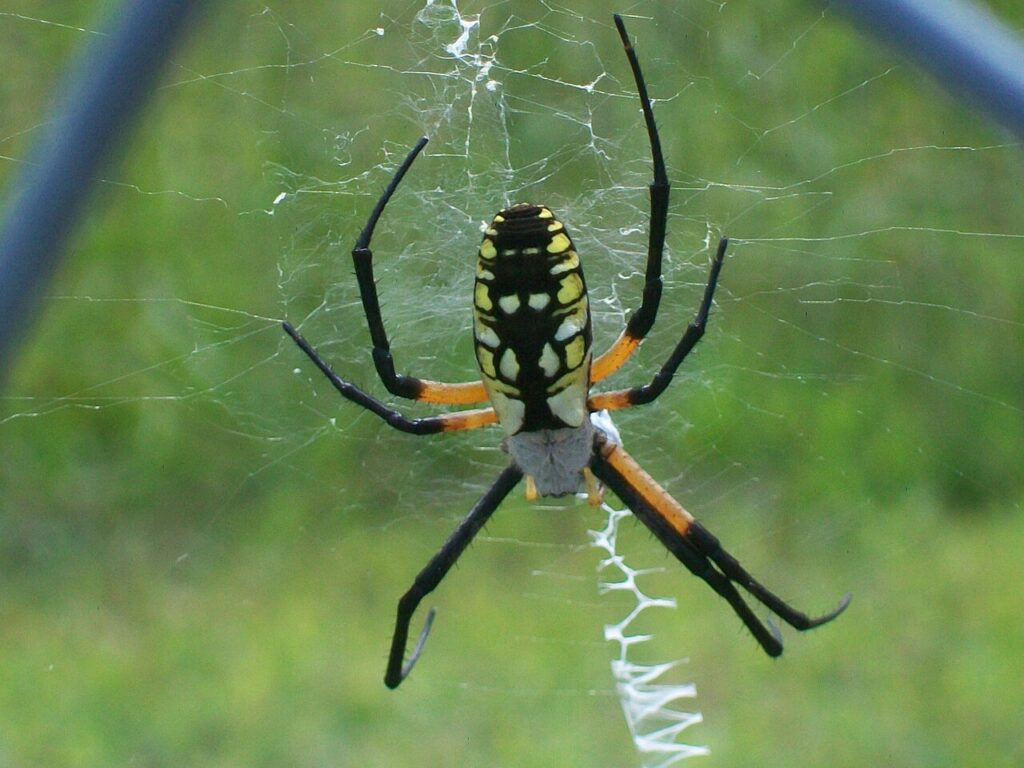
Table of Contents
How to Identify a Yellow Garden Spider
- Female size: body 3/4 to 1 inch long, with a leg span well over 2 inches.
- Male size: about 1/4 inch, and rarely noticed.
- Abdomen: egg-shaped, black with bright yellow or orange patches, notched at the front and slightly pointed at the back, with a small hump on each side.
- Head: covered in short silver hairs.
- Legs: black with yellow-orange bands; young spiders also have banded legs.
- Position: hangs head-down at the center of its web in daylight.
The Web and Its Zigzag
Only the female builds the large web. It is a round orb, commonly 2 to 3 feet across, hung vertically between plants, fences, or porch rails. A thick, white zigzag band of silk runs down the center, called a stabilimentum, which gives the spider the name “writing spider.”
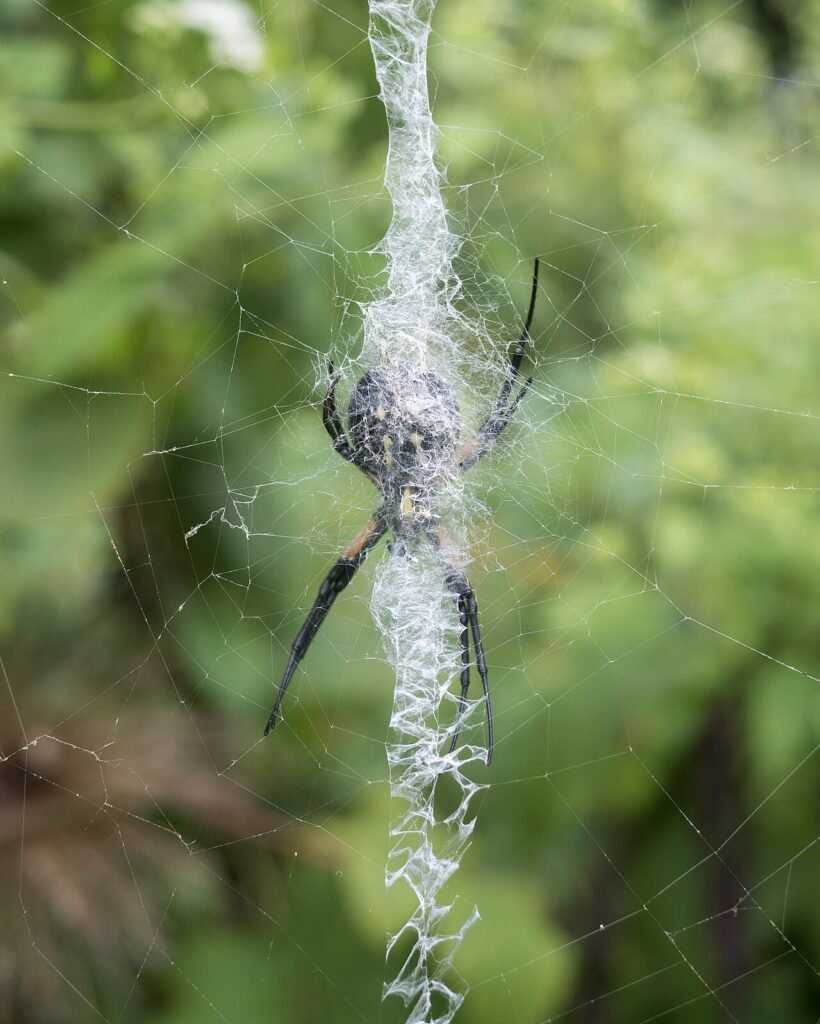
Nobody knows for sure what the zigzag is for. Researchers suggest it warns birds away so they don’t fly through and wreck the web, attracts insects by reflecting ultraviolet light, or helps the spider look bigger or hide. Early naturalists thought it strengthened the web, which is where the name stabilimentum comes from.
When disturbed, the spider shakes the web hard, blurring its outline. If that fails, it drops to the ground and hides.
Where and When You See Them
Yellow garden spiders live across most of the United States, in sunny gardens, tall weeds, fields, fence lines and shrubs, and around homes. Adults appear from July through October, when the webs are largest. A spider tends to stay in the same spot all season.
Life Cycle
In late summer and fall, the female makes up to four brown, papery, round egg sacs, each about the size of a ping-pong ball and holding 400 to over 1,000 eggs. She hangs them near the web. The eggs hatch in fall, but the spiderlings stay inside the sac all winter. In spring, they come out and drift away on silk threads in the wind. The adults die at the first hard frost.
What They Eat
Yellow garden spiders catch flying and jumping insects in their webs: grasshoppers and katydids especially, plus flies, aphids, wasps, bees and butterflies. They can subdue prey twice their size. When an insect hits the web, the spider wraps it in silk and bites it.
Is the Yellow Garden Spider Dangerous?
No. Its venom isn’t medically significant to people. It isn’t aggressive and only bites when grabbed, usually by someone handling a female guarding her egg sac. A bite can hurt but is no worse than a bee or wasp sting. Watch for signs of an allergic reaction, as with any sting.
Yellow Garden Spider vs Banana Spider and Banded Garden Spider
| Spider | Size (female body) | Look | Web |
|---|---|---|---|
| Yellow garden spider | 3/4 to 1 inch | Black and bright yellow abdomen, silver head, banded legs | Round orb about 2 feet across with a bold zigzag |
| Golden silk orb-weaver (banana spider) | 1 1/2 to 2 inches | Silvery head, orange-tan abdomen with yellow spots, banded legs with hair tufts | Huge golden web, often 3 to 6 feet across, usually without a zigzag |
| Banded garden spider | About 5/8 to 1 inch | Pale yellow to silver abdomen with many thin black stripes, no side humps | Similar orb; zigzag often missing or patchy |
Should You Remove One?
Leave it if you can. A yellow garden spider spends the season eating insects in one spot and dies with the first hard frost. Gardeners value them, though they also catch some bees and butterflies.
If a web crosses a doorway or garden path, coax the spider into a large container and move it to a shrub or fence in another part of the yard. Wear gloves if you prefer, and leave egg sacs where you find them unless you want hundreds of spiderlings nearby in spring.
Garden spider extras
- Garden gloves for moving spiders and webs
- Bug catcher container for safe relocation
- Spider field guide for identifying garden spiders
As an Amazon Associate, Pestbugs earns from qualifying purchases.
FAQs
No. Like most spiders it has venom for its prey, but it is not medically important. It rarely bites, usually only when a female guarding her egg sac is handled, and the bite hurts no more than a bee sting.
Because it weaves a thick white zigzag band of silk down the center of its web, which looks like handwriting. The band is called a stabilimentum.
Scientists still debate it. Leading ideas include that it warns birds so they don’t fly through the web, attracts insects, helps hide or protect the spider, or, as once thought, strengthens the web, which gave it the name stabilimentum.
Adults are most noticeable from July to October, when their webs are largest. They die at the first hard frost, and their young spend the winter inside the egg sac and come out in spring.
It is best left alone, since it eats grasshoppers, flies and other garden insects. If its web is across a doorway or path, move it with a large container to another part of the garden.
No. “Banana spider” usually means the golden silk orb-weaver, which is bigger, has an orange-tan abdomen with yellow spots and builds a huge golden web without the bold zigzag.
Sources
- Missouri Department of Conservation: Black-and-Yellow Garden Spider
- Penn State Extension: Yellow Garden Spider
- Penn State Extension: Banded Garden Spider
- Clemson HGIC: Big Yellow Spiders in South Carolina
- UF/IFAS: Golden Silk Spider
- South Dakota State University Extension: Black and Yellow Garden Spiders
- University of Michigan Animal Diversity Web: Argiope aurantia
Facts in this guide are checked against the sources above and reviewed when they change. See how we research in our editorial policy.