
The cockroaches most often found in U.S. homes are the German, American, oriental, brownbanded and smokybrown cockroaches. The small, tan German cockroach with two dark stripes behind its head is the one that infests kitchens; the large, reddish-brown American cockroach comes up from drains and basements; the shiny black oriental cockroach lives in damp spots. Several outdoor roaches, including wood, Australian, Asian and Florida woods cockroaches, wander inside but rarely establish. Identifying the type tells you where they breed and how to get rid of them.
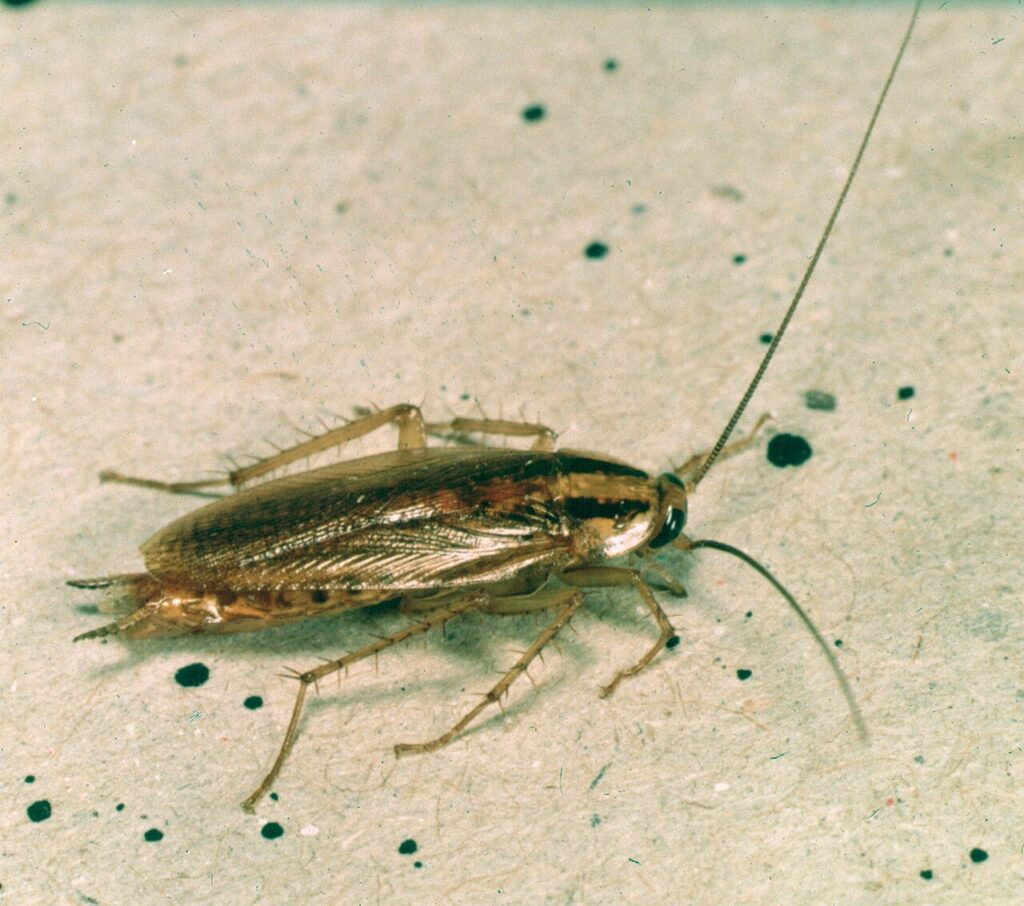
Table of Contents
Types of Cockroaches at a Glance
| Cockroach | Size | Look | Flies? | Where it lives |
|---|---|---|---|---|
| German | 1/2 to 5/8 inch | Tan, two dark stripes behind the head | No | Indoors only: kitchens, bathrooms |
| American | 1 1/2 to 2 inches | Reddish-brown, pale yellow band around the shield | Glides, rarely flies | Sewers, drains, basements |
| Oriental | 1 to 1 1/4 inches | Shiny black to dark brown; short wings | No | Cool, damp ground-level spots |
| Brownbanded | About 1/2 inch | Light bands across wings and body | Males only | Warm, dry rooms; furniture, high walls |
| Smokybrown | 1 1/4 to 1 1/2 inches | Uniform dark mahogany | Yes | Outdoors in trees and mulch; attics |
| Australian | About 1 1/4 to 1 1/2 inches | Reddish-brown, yellow stripe on each wing edge | Glides | Outdoors in the Southeast; indoors in cold weather |
| Florida woods (palmetto bug) | 1 1/4 to 1 1/2 inches | Reddish-brown to black, wide, short wing pads | No | Outdoors in Florida and the Gulf Coast |
| Asian | 1/2 to 5/8 inch | Like a German cockroach | Yes, strongly | Outdoors in leaf litter and lawns; flies to lights |
| Wood cockroaches | 3/4 to 1 inch | Light brown to dark; some with cream edges | Males only | Outdoors in woodpiles and leaf litter |
| Turkestan | 1/2 to 1 inch | Female dark with cream marks; male tan | Females no | Outdoors in the Southwest and California |
German Cockroach
The German cockroach is the main indoor roach in the U.S. and the hardest to control. It is about 1/2 to 5/8 inch long, light brown, with two dark parallel stripes on the shield behind the head. It has full wings but doesn’t fly. It lives only indoors, in kitchens, bathrooms and anywhere food and water are handy, and spreads between apartments through walls and plumbing. Females carry a light brown egg case holding 30 or more eggs until just before it hatches. Full guide: German cockroach identification and control.
American Cockroach
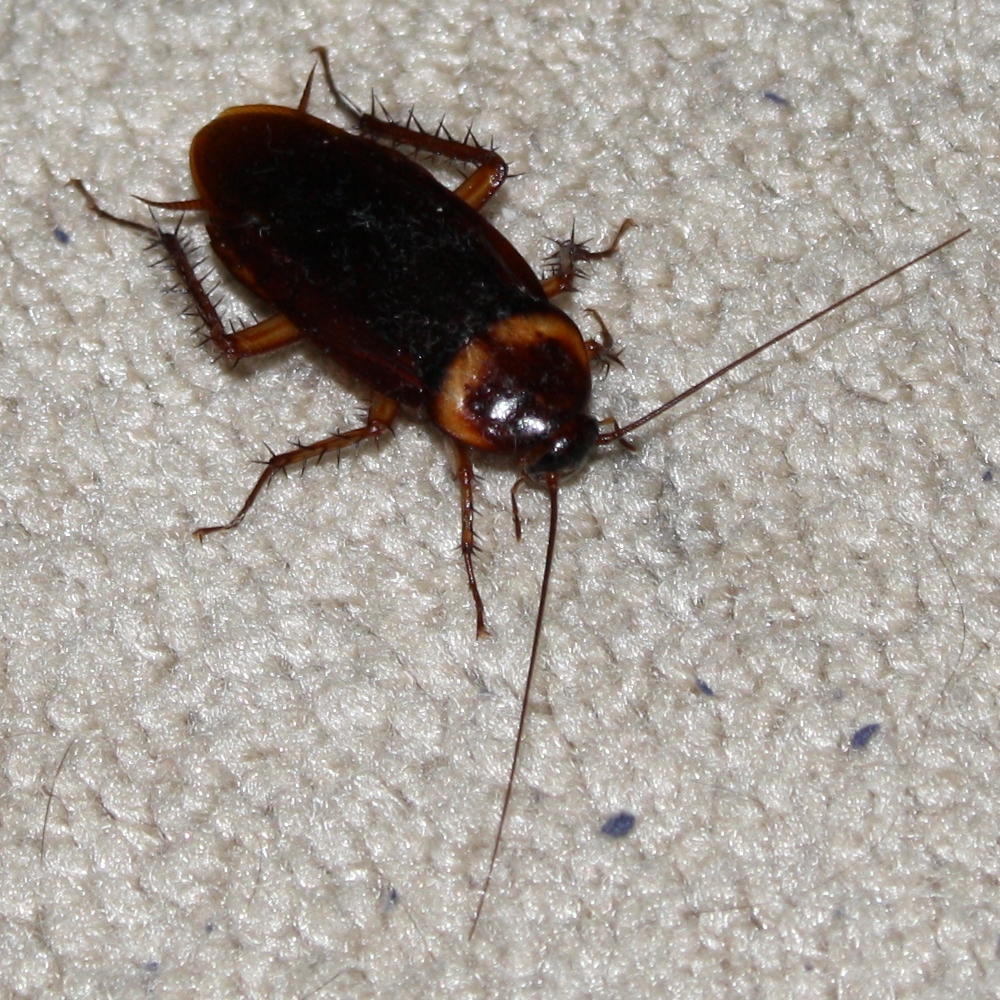
The American cockroach is the largest common roach, about 1 1/2 to 2 inches long, reddish-brown with a pale yellow band around the edge of the shield behind its head. It can fly or glide but rarely does. It lives in sewers, storm drains, water meter boxes and basements and enters buildings through floor drains, basements and damaged pipes. The female drops a dark egg case holding about 12 to 15 eggs. It is one of the roaches called a “palmetto bug” or “water bug.”
Oriental Cockroach
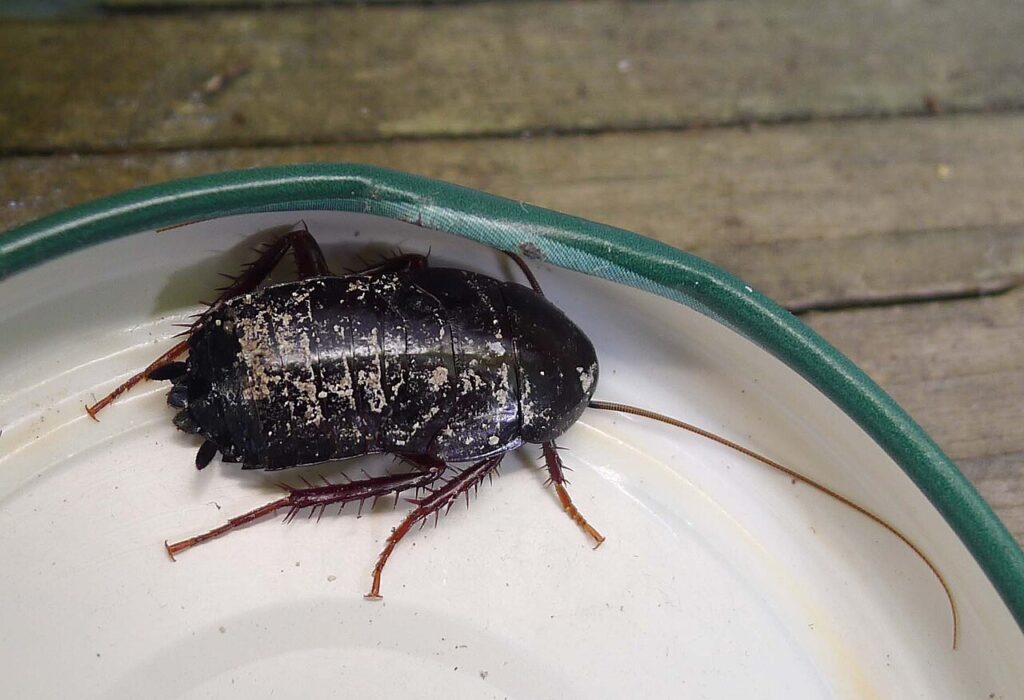
The oriental cockroach is about 1 to 1 1/4 inches long and shiny black to dark brown. Males have wings covering about half the abdomen; females have only tiny wing pads. Neither can fly, and they can’t climb smooth walls. They prefer cool, damp, ground-level places: basements, crawl spaces, floor drains and mulch. They are sometimes called “water bugs” or “black beetles.” See water bug vs roach.
Brownbanded Cockroach
The brownbanded cockroach is about 1/2 inch long, the same size as a German cockroach. Males are golden tan and females darker brown, and both have two light bands across the wings and body. Males sometimes fly when disturbed in warm rooms. Unlike most roaches, it doesn’t need to be near water: it hides high on walls and ceilings, behind pictures, inside furniture and electronics. Females glue egg cases under furniture and on ceilings. Baits work less well on this species.
Smokybrown Cockroach
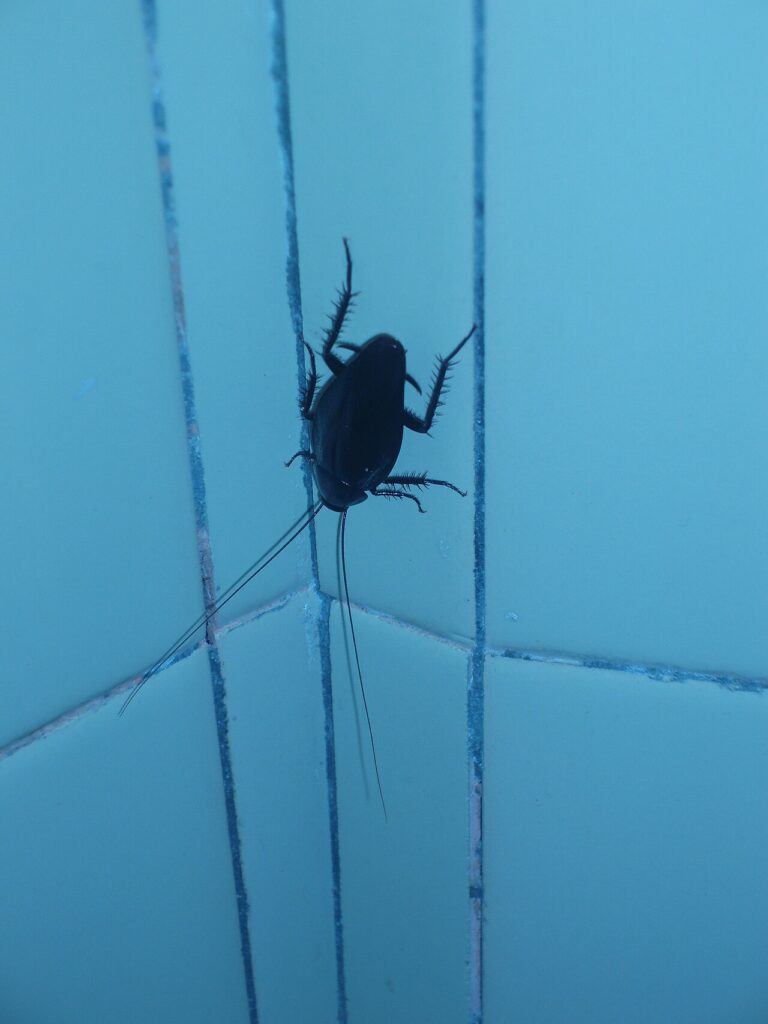
The smokybrown cockroach is about 1 1/4 to 1 1/2 inches long and a uniform dark brown to mahogany, without the pale band of the American cockroach. Its wings are longer than its body, and it flies readily on warm, humid evenings. It lives outdoors in tree holes, mulch, palm fronds and gutters, especially in older neighborhoods with mature trees in the Southeast, and gets into attics and soffits. Young nymphs are black with white bands and white-tipped antennae.
Australian Cockroach
The Australian cockroach looks like an American cockroach, about 1 1/4 to 1 1/2 inches long and reddish-brown, but has a bright yellow stripe along the outer edge of each front wing. It glides. It is the most common outdoor cockroach in south Florida and also lives along the coastal Southeast, under bark, in firewood and in damp areas, and comes indoors in cold weather.
Florida Woods Cockroach (Palmetto Bug)
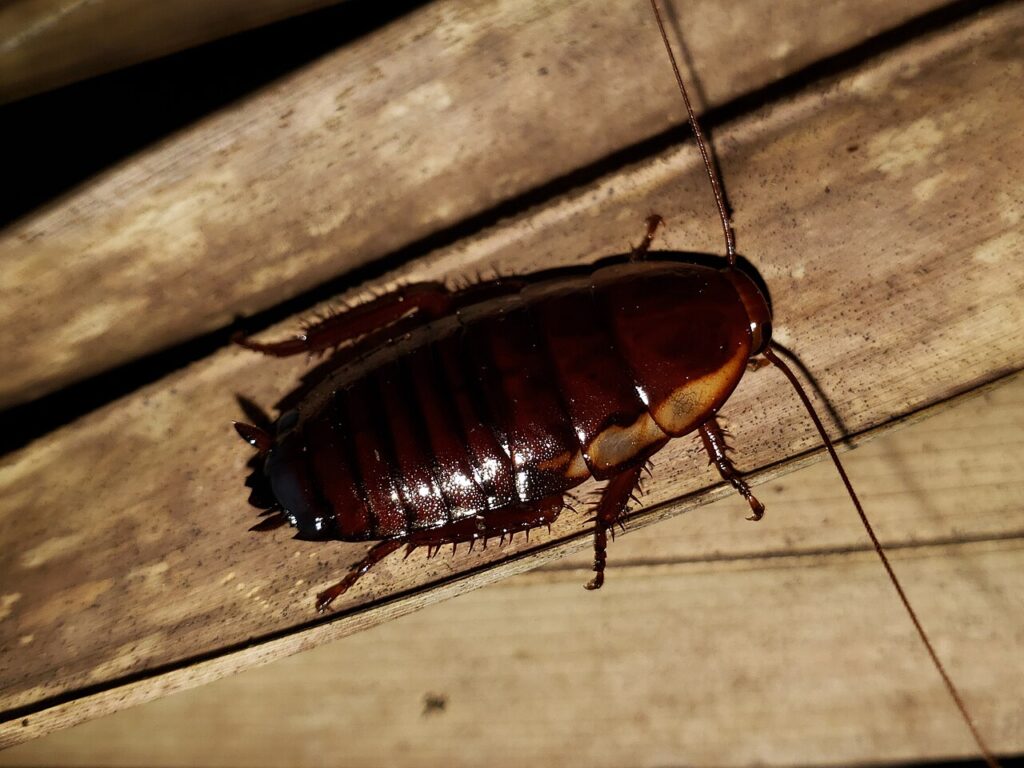
The Florida woods cockroach is a broad, slow roach about 1 1/4 to 1 1/2 inches long, reddish-brown to nearly black, with short wing pads and no flight. It lives outdoors in Florida and along the Gulf Coast in palms, tree cavities, leaf litter and woodpiles. It sprays an oily, foul-smelling liquid when threatened, earning the names “stinkroach” and “skunk cockroach.” It comes indoors only occasionally, often on firewood, and rarely survives long inside. More in palmetto bug vs cockroach.
Asian Cockroach
The Asian cockroach is almost identical to the German cockroach: tan, 1/2 to 5/8 inch long, with two stripes behind the head. The difference is behavior. It lives outdoors in leaf litter, mulch and grass, sometimes in huge numbers, and flies strongly toward lights at dusk, landing on lamps, windows and TV screens. It was first found in the U.S. in Florida in 1986.
Wood Cockroaches
Wood cockroaches are outdoor roaches that live in leaf litter, logs, loose bark and woodpiles. Males are about 1 inch long with long wings and fly to porch lights; females are smaller with short wings. Some have cream-colored edges on the wings and shield. They come in on firewood or through open doors in spring and summer, die within days and don’t breed indoors, so no pesticide is needed: turn off porch lights and keep doors closed.
Turkestan Cockroach
The Turkestan cockroach is an outdoor roach spreading in California, the Southwest and west Texas, where it is replacing the oriental cockroach. Females are about 1 inch long and dark brown to black with cream markings and short wings; males are smaller and tan with yellowish wings. They live in water meter boxes, compost, leaf litter, cracks in concrete and sewers.
White, Flying and Big Cockroaches
- White cockroaches: not a species. A roach that has just molted is white for a few hours until its new skin hardens and darkens.
- Flying cockroaches: Asian and smokybrown cockroaches fly well; American and Australian cockroaches glide; male brownbanded and wood roaches fly. German, oriental and Florida woods cockroaches don’t fly.
- Big cockroaches: the American cockroach is the largest common one, up to 2 inches. The Florida woods, Australian and smokybrown cockroaches are close behind.
- Baby cockroaches: nymphs of every species are wingless and smaller than adults; see baby cockroach pictures.
Why the Type Matters
Indoor roaches such as German and brownbanded cockroaches breed inside and need baits, sanitation and sealing indoors. Outdoor roaches such as American, smokybrown, Australian, wood and Florida woods cockroaches mostly need sealing, clearing mulch and leaf litter from the foundation, fixing moisture problems and changing outdoor lights. All cockroaches carry allergens and bacteria; see how to get rid of cockroaches for the full plan.
Cockroach control supplies
- Cockroach gel bait for indoor species
- Sticky traps to identify and monitor
- Outdoor granular roach bait for perimeter species
- Door sweeps to keep outdoor roaches out
As an Amazon Associate, Pestbugs earns from qualifying purchases.
FAQs
In the U.S., the German cockroach is by far the most common indoor roach. American, oriental, brownbanded and smokybrown cockroaches also get into homes, along with outdoor species such as wood, Australian and Asian cockroaches that wander in.
Asian and smokybrown cockroaches fly well, American and Australian cockroaches glide, and male brownbanded and wood cockroaches fly. German, oriental, Turkestan female and Florida woods cockroaches can’t fly.
The American cockroach, at about 1 1/2 to 2 inches long. The Florida woods cockroach and Australian cockroach come close at about 1 1/4 to 1 1/2 inches.
A white cockroach is a roach that has just shed its skin. It stays soft and white for a few hours until its new outer layer hardens and darkens. It isn’t a separate species or an albino.
Often. Small tan roaches with two dark stripes behind the head are usually German cockroaches or their nymphs. Brownbanded cockroaches are similar in size but have light bands across the body instead of stripes.
A palmetto bug is a cockroach. The name is a regional nickname in the Southeast for large outdoor roaches such as the Florida woods, American and smokybrown cockroaches.
Sources
- UC IPM Pest Notes: Cockroaches
- Texas A&M AgriLife Extension: Cockroach Biology and Management (ENTO-037)
- University of Kentucky: Cockroach Control
- University of Florida IFAS: Australian Cockroach
- University of Florida IFAS: Florida Woods Cockroach
- Texas A&M Urban Entomology: Asian Cockroach
- Penn State Extension: Wood Cockroaches
- UC IPM: Turkestan Cockroach
Facts in this guide are checked against the sources above and reviewed when they change. See how we research in our editorial policy.