
Clothes moths are small, golden-buff moths about 1/4 inch long whose creamy-white larvae eat wool, cashmere, fur, silk, feathers and felt, leaving irregular holes, silky webbing and tiny droppings. The adults avoid light and hide in closets, so damage is often the first sign. To get rid of them, find every infested item, vacuum thoroughly, and wash in hot water, dry-clean, or freeze items at 0°F for a week. Then store clean woolens in airtight containers. Pheromone traps only monitor; they don’t solve the problem.
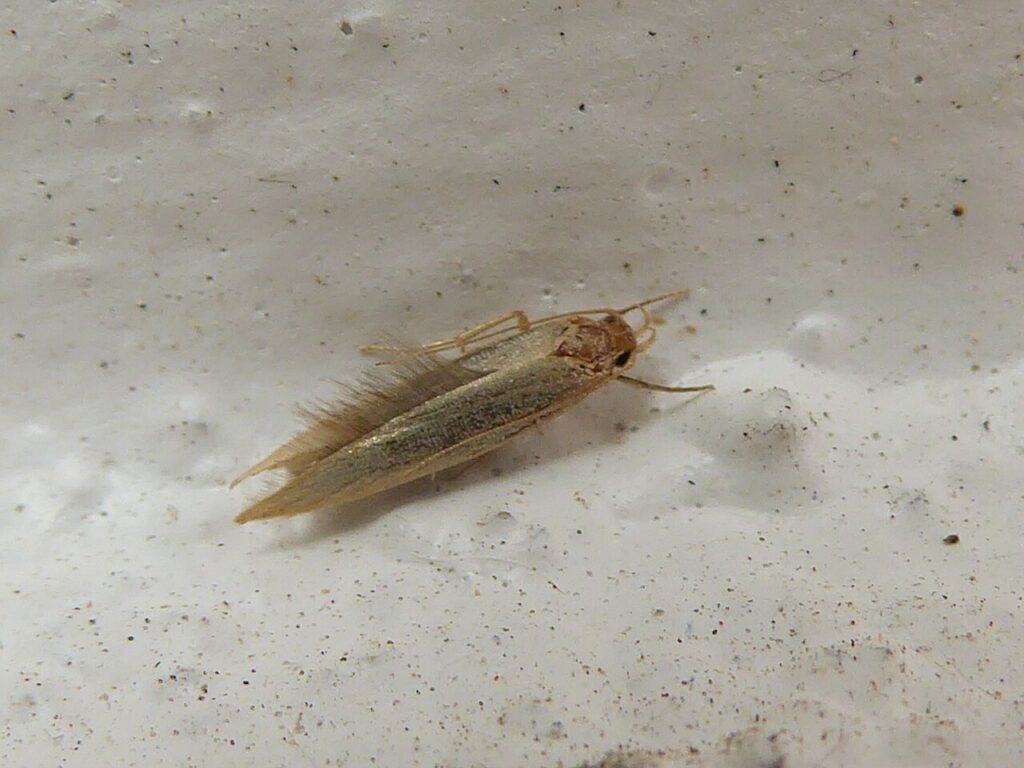
Table of Contents
How to Identify Clothes Moths
Adults
- Size: about 1/4 inch long at rest, with a wingspan of about 1/2 inch.
- Color: uniform gold or buff, with a shiny sheen.
- Head: a tuft of reddish-gold hairs.
- Wings: narrow and fringed with fine hairs.
- Behavior: avoid light, rarely seen, and run or flutter weakly rather than fly. Males fly more than females.
Adults don’t feed or damage fabric. All the damage comes from the larvae.
Larvae
- Creamy-white caterpillars with a dark brown head, up to about 1/2 inch long
- Webbing clothes moth larvae spin silky tubes or mats mixed with fibers and droppings, often under collars and cuffs
- Casemaking clothes moth larvae drag a small, cigar-shaped silk case, open at both ends, that takes on the color of the fabric they eat
The two common species
| Webbing clothes moth | Casemaking clothes moth | |
|---|---|---|
| Adult | Plain gold-buff, reddish head tuft | Browner wings with faint dark spots, lighter head hairs |
| Larva | Spins webbing tunnels and mats | Carries a portable silk case |
| Signs | Webbing and silk tubes on the fabric | Small cases; larvae may climb walls to pupate |
Clothes Moth Life Cycle
Females lay about 40 to 300 tiny, pinhead-sized eggs, glued loosely to wool and other fabrics the larvae can eat, over two to three weeks before dying. Eggs hatch in 4 to 10 days in warm weather, longer in winter. The larvae feed for anywhere from about a month to two years depending on temperature and food, then pupate in a silk cocoon. Egg to adult takes from one month to two years, and heated homes let moths keep breeding through winter.
What Clothes Moths Eat
- Wool, cashmere, mohair and alpaca
- Fur, feathers, down, felt and hair
- Silk and leather
- Piano felts, wool rugs, upholstery, taxidermy and brush bristles
- Lint, pet hair and dust in vents and under furniture
Clothes moths rarely eat cotton, linen or synthetics unless the fabric is blended with wool or stained with food, sweat, body oils or urine. Stained, stored clothing is the most attractive.
Signs of Clothes Moths
- Irregular holes or thin, grazed patches in sweaters, coats, suits and blankets
- Silky webbing or tubes, especially under collars, cuffs and folds
- Tiny droppings the color of the fabric
- Small cigar-shaped cases on fabric or climbing walls
- Fur with hairs clipped at the base, leaving loose fur and bare hide
- Small golden moths in closets or dark corners
Clothes moths vs pantry moths vs carpet beetles
| Clothes moth | Pantry moth | Carpet beetle | |
|---|---|---|---|
| Adult | Small, plain gold, avoids light | Bigger, two-toned wings, flies to light in kitchens | Tiny round beetle, often on windowsills |
| Larva | Cream caterpillar, brown head | Cream caterpillar in dry food | Hairy, bristly larva |
| Eats | Wool, fur, silk, feathers | Flour, cereal, nuts, pet food | Wool, fur, feathers, dead insects, lint |
| Signs | Webbing, cases, grazed fabric | Webbing in food | Shed skins, no webbing |
See pantry moths and carpet beetles if your signs fit those better.
Where Clothes Moths Hide
- Closets, wardrobes, dressers and chests
- Stored woolens in boxes, basements and attics
- Edges and undersides of wool rugs, and carpet under heavy furniture
- Upholstered furniture and heating vents with lint and pet hair
- Old bird or animal nests and dead insects in attics and walls
How to Get Rid of Clothes Moths
- Find the source. Check every wool, silk, fur and feather item in closets, drawers, storage boxes and rugs. Bag and discard anything heavily damaged.
- Vacuum thoroughly. Closet floors and shelves, carpet edges, under furniture, baseboards, vents and upholstery. Empty the vacuum outdoors right away.
- Wash or dry-clean. Wash washable items in water at least 120°F for 20 to 30 minutes, or dry-clean them. A hot dryer also kills eggs and larvae.
- Freeze what you can’t wash. Seal items in plastic bags and freeze at 0°F or colder for at least a week. Let them warm to room temperature for a day before opening the bags.
- Or heat-treat. Holding items above 120°F for at least 30 minutes kills all stages, if the fabric can tolerate it.
- Brush and air. Brush seams, pockets and folds and hang woolens in the sun for several hours.
- Monitor with pheromone traps. They catch only males and show whether moths remain. Webbing and casemaking moths need different lures.
About mothballs, cedar and sprays
- Mothballs and crystals (naphthalene or paradichlorobenzene) work only sealed in an airtight container at the strength on the label. In open closets larvae keep feeding. They are toxic, so keep them away from children and pets, don’t let them touch fabric, and air clothes out afterward.
- Cedar kills only small larvae and loses strength after a few years. It helps protect moth-free clothes, not infested ones.
- Insecticide sprays have a limited role: spot treatments in cracks and closet corners, labeled for fabric pests. Never spray clothing or bedding.
Call a professional for persistent infestations or valuable rugs and furs.
How to Prevent Clothes Moths
- Clean woolens before storing them; cleaning kills eggs and removes the sweat and food stains that attract larvae.
- Store clean items in airtight plastic bins, vacuum-sealed bags or tightly sealed garment bags.
- Wear, brush or air stored woolens every month or two.
- Vacuum rugs and under furniture regularly, including the back of rugs.
- Store valuable furs in professional cold storage.
For why moths go after clothing, see what do moths eat.
Clothes moth supplies
- Clothes moth pheromone traps for closets
- Airtight vacuum storage bags for woolens
- Zippered garment bags for coats and suits
- Garment brush for brushing seams and folds
As an Amazon Associate, Pestbugs earns from qualifying purchases.
FAQs
Adults are small, about 1/4 inch long at rest, uniformly gold or buff, with narrow, fringed wings and a tuft of reddish hairs on the head. They avoid light and tend to run or flutter weakly rather than fly. The larvae are creamy-white caterpillars with a brown head.
Keratin, the protein in animal fibers: wool, cashmere, fur, silk, feathers, felt, leather and hair. They rarely eat cotton or synthetics unless the fabric is blended with wool or stained with food, sweat or body oils. Adults don’t eat at all.
Look for irregular holes or thin, grazed patches in wool and silk, silky webbing or tubes in collars and cuffs, tiny droppings, small cigar-shaped cases, and fur with loose hair. Seeing small golden moths in closets or dark corners is another sign.
Find and discard or treat every infested item, vacuum closets, carpets and under furniture, then wash fabrics in water at least 120°F, dry-clean them, or freeze them at 0°F for at least a week. Store clean woolens in airtight containers.
No. They attract only males, so they show whether moths are present and how many, but they won’t stop females from laying eggs. Use them to monitor, not as the treatment.
Not reliably. Cedar oil kills only small larvae and loses strength after a few years. It can help protect clothes that are already moth-free, but it won’t stop an infestation.
Sources
- University of Kentucky Entomology: Clothes Moths (ENTFACT-609)
- UC IPM Pest Notes: Clothes Moths
- NC State Extension: Clothes Moths and Carpet Beetles
- Penn State Extension: Clothes Moth
- University of Florida IFAS: Clothes Moths
- Purdue Extension: Household and Structural Insects (E-18)
Facts in this guide are checked against the sources above and reviewed when they change. See how we research in our editorial policy.