
The most effective way to get rid of moles in your yard is to trap them. Find an active tunnel by stepping down a few raised ridges and checking which ones are pushed back up the next day, then set a harpoon or scissor-jaw mole trap on that straight, active runway. Worm-shaped baits made for moles are the other option. Grub killers, castor oil, sonic spikes, chewing gum and grain-based poisons don’t reliably work. Moles eat mainly earthworms, not grubs, so killing grubs won’t make them leave.
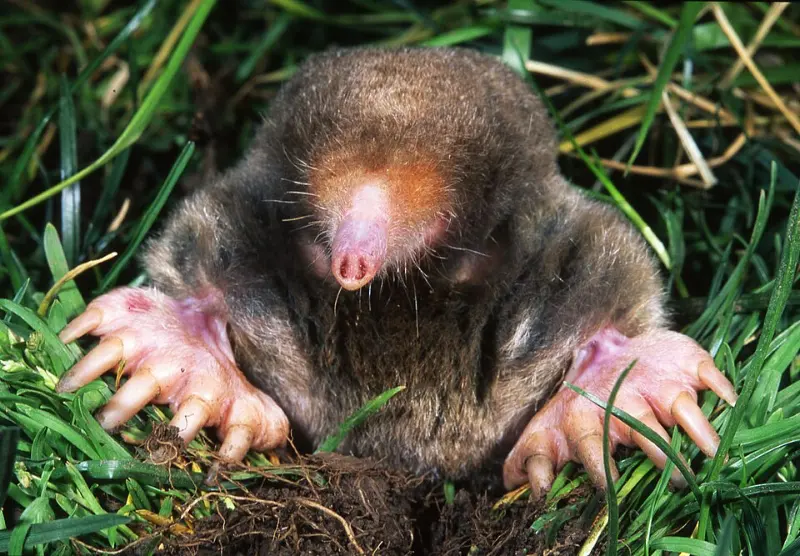
Table of Contents
Is It a Mole? Signs in Your Lawn
Moles live almost entirely underground, so you rarely see one. You see their tunnels:
- Raised ridges: shallow feeding tunnels just under the grass that look like long, winding bumps. Many are used only once.
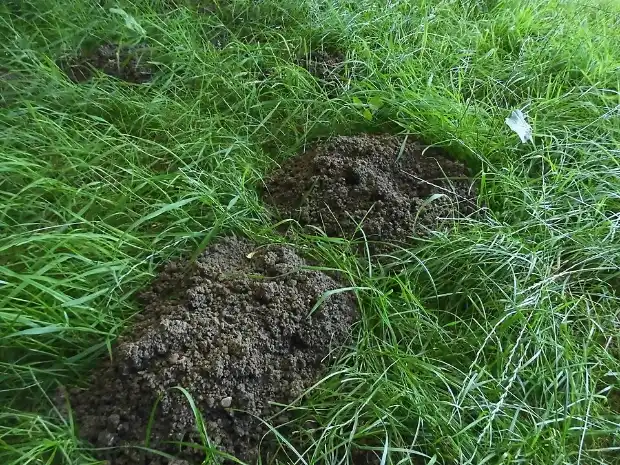
- Molehills: round, volcano-shaped piles of loose soil pushed up from deeper tunnels, with no open hole.
- Spongy lawn: grass that feels soft underfoot where tunnels run below.
Moles are insectivores, related to shrews, not rodents. They eat 70 to 100 percent of their body weight in earthworms and insects each day, which is why a few moles can tunnel so much. A typical lawn may have only about three moles per acre. Moles rarely eat plants; if bulbs, roots or bark are being eaten, the culprit is usually a vole or a gopher.
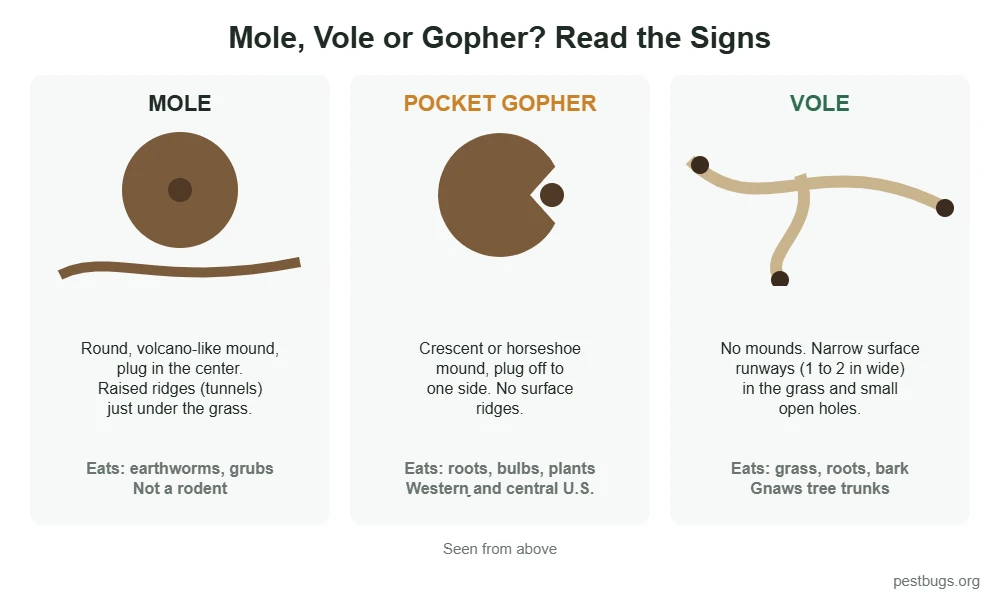
See how to get rid of voles and how to get rid of gophers if the signs point to them.
Brown patches of dead grass that peel back like carpet, without ridges or mounds, are more likely grub damage.
How to Get Rid of Moles: Step by Step
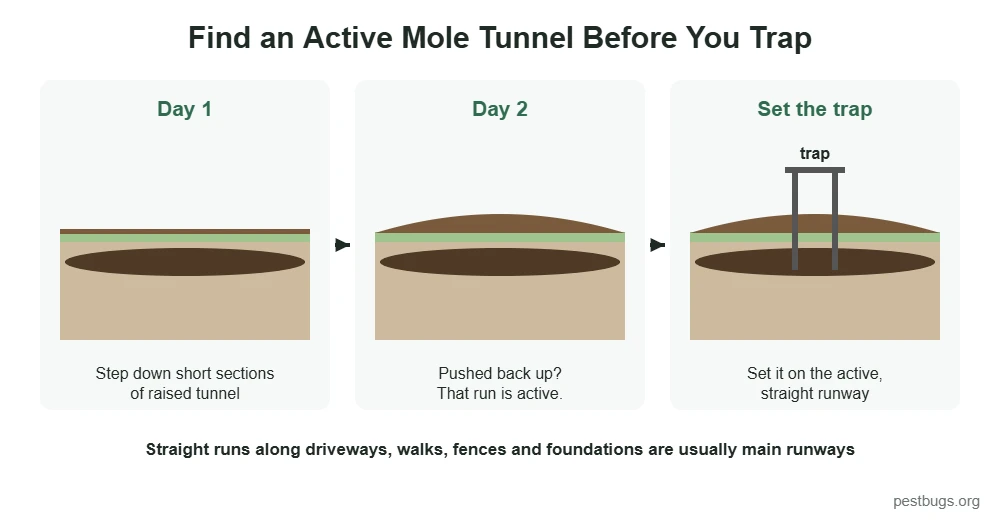
- Find active tunnels. Step down short sections of raised ridges, or mark a few molehills. Check the next day: ridges pushed back up are active.
- Choose a main runway. Straight tunnels along driveways, sidewalks, fences, foundations and the edge of the lawn are usually main runways that moles use again and again. Moles may use winding feeding tunnels only once.
- Set the trap. Use a harpoon trap for shallow tunnels just under the surface, or a scissor-jaw trap for deeper runs. Follow the trap instructions exactly, and wear gloves.
- Check daily and move traps that haven’t caught anything in two or three days to another active run.
- Trap in spring and fall, when moles are most active near the surface. In dry summers and frozen winters, they move deeper, 6 to 24 inches down, and are harder to catch.
Some states restrict body-gripping traps, so check local rules before you buy. If trapping isn’t practical, a worm-shaped bait containing bromethalin, placed in active tunnels as the label directs, is the other option that targets moles. It is poisonous to pets, so follow the label closely.
What Doesn’t Work on Moles
- Grub control: moles eat mainly earthworms, and even grub-free lawns keep their moles. Treat grubs only if grubs are damaging the lawn; see lawn grubs.
- Grain or peanut poisons: moles don’t eat seeds or grain.
- Castor oil repellents: early tests looked promising, but results have not held up consistently.
- Sonic, ultrasonic and vibrating stakes, and pinwheels.
- Chewing gum, mothballs, human hair or razor blades in tunnels.
- Gas cartridges: only occasionally effective, because moles quickly seal off tunnels.
Do You Need to Get Rid of Moles?
Not always. Moles loosen and aerate soil and eat soil insects. Their activity is often seasonal and can stop on its own. If the damage is limited to a few ridges, pressing them back down with your foot or a lawn roller, raking out molehills and reseeding bare spots may be enough.
Mole control tools
- Harpoon mole trap for shallow tunnels
- Scissor-jaw mole trap for deeper runs
- Worm-shaped mole bait (keep away from pets)
- Lawn roller for flattening ridges
As an Amazon Associate, Pestbugs earns from qualifying purchases. Check local rules on mole traps before buying.
FAQ
Trapping. Find an active, straight tunnel with the stomp test, then set a harpoon or scissor-jaw trap on it. Spring and fall are the best times.
No. Moles eat mainly earthworms, and they stay even in grub-free lawns. Grub control won’t solve a mole problem.
Not reliably. Early results were encouraging, but further testing has not shown consistent results.
Usually fewer than you think. There are often only about three moles per acre, and one mole can dig many tunnels.
Moles are insect-eaters that dig tunnels and leave raised ridges and round mounds. Voles are small rodents that make surface runways in the grass and eat plants, roots and bark.
Moles are active year-round, but most active near the surface in spring and fall, especially in the early morning and late afternoon and on cloudy, damp days.
Sources
- Purdue University: How do I get rid of moles in my lawn?
- University of Maryland Extension: Moles
- Iowa State University Extension: Moles in the Lawn, Control
- Kansas State University: Traps are the most effective way to catch moles
- UC IPM: Pocket Gophers (mole vs gopher mounds)