
To get squirrels out of your attic, first make sure there are no babies inside (young may be present from February through August), then install a one-way exclusion door over the main entry hole so squirrels can leave but not return. Once they are out, seal every opening with heavy 1/2-inch wire mesh or aluminum flashing, and trim tree limbs back 6 to 8 feet from the roof. Don’t seal squirrels in: trapped squirrels chew new holes and can die inside. Squirrels are game animals in most states, so check your state wildlife agency’s rules before trapping.
Table of Contents
Signs of Squirrels in the Attic
- Noises in the attic or walls: scurrying, scratching and gnawing.
- Chewed entry holes in siding and under the eaves, which squirrels gnaw to make nest openings.
- Chewed insulation, wood and wiring inside the attic, plus nests of leaves and insulation.
- Squirrels running along power lines, fences or overhanging branches onto the roof.
Which squirrel? Eastern gray squirrels and flying squirrels cause most squirrel damage. Flying squirrels often nest in attics and between walls.
Why Squirrels in the Attic Are a Problem
Once inside, squirrels damage walls, insulation and stored items, and they gnaw electrical wires, which can leave bare wires and start a fire. They also chew siding and eaves to make new openings.
How to Get Squirrels Out of the Attic
1. Check for young first
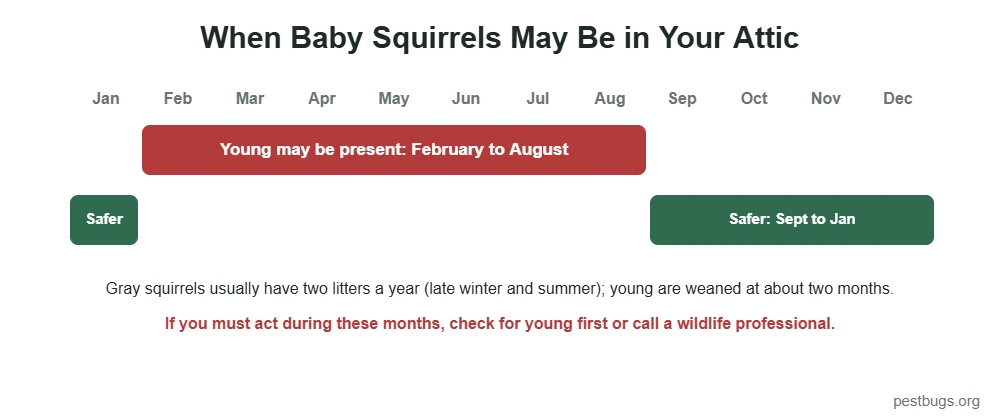
Squirrel young may be in an attic from February through August. Gray squirrels usually have two litters a year, born in late winter and again in summer, and the young are weaned at about two months. Evicting a mother at the wrong time leaves babies behind, and she will chew her way back in to reach them. If you hear high-pitched squeaks or know there is a nest, wait until the young are moving in and out on their own, or call a wildlife professional.
2. Install a one-way door
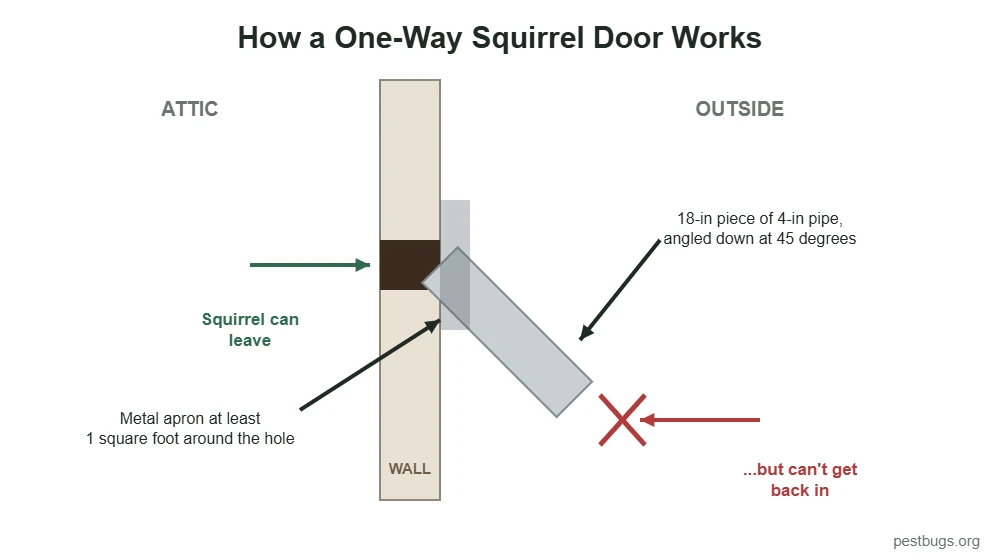
Seal every other opening first and make sure vents and chimneys are secure. Then mount a one-way door over the main entry hole, with a solid apron of at least 1 square foot around the opening to stop squirrels chewing around it. A simple version is an 18-inch piece of 4-inch plastic pipe fixed over the hole and angled down at 45 degrees. To check whether squirrels are still using a hole, stuff it loosely with newspaper and see if it is pushed out.
3. Seal the openings
After a few days with no activity, remove the door and close the hole with heavy 1/2-inch wire mesh, aluminum flashing or other solid repairs. Plywood alone isn’t enough: a gray squirrel has been recorded gnawing through 1/2-inch plywood to reach her young. As a precaution, set a cage trap inside the attic so no squirrel is accidentally locked in.
4. Cut off the routes onto the roof
Trim trees and limbs 6 to 8 feet back from the house, and cut back ivy and other climbing plants. Never install guards on power lines yourself; contact your power company.
Trapping Squirrels
Use cage or box traps at least 5 x 5 x 18 inches. Bait with apple or orange slices, walnuts or pecans, peanut butter, corn or sunflower seeds, and pre-bait for two to three days with the doors tied open. Check traps in the morning and evening. Fox and gray squirrels are game species in most states, so a trapping permit may be needed; contact your state wildlife agency before trapping or moving squirrels.
What Doesn’t Work Well
- Mothballs (naphthalene): may discourage squirrels only briefly and can cause severe distress to people, so they should not be used in the attic of an occupied home.
- Lights, noise and other frightening devices: none are proven effective.
- Taste repellents: very limited success.
- Poison: no toxicants are registered for tree squirrels.
Squirrel exclusion supplies
- One-way squirrel exclusion door
- Heavy 1/2-inch wire mesh
- Aluminum flashing
- Squirrel cage trap (at least 5 x 5 x 18 inches)
As an Amazon Associate, Pestbugs earns from qualifying purchases. Check your state’s rules before trapping.
FAQ
Make sure no young are inside, seal all other openings, put a one-way door over the main entry hole, then seal that hole with heavy 1/2-inch wire mesh or metal flashing once the squirrels are gone.
Young may be present from February through August. Gray squirrels usually have two litters a year, one in late winter or early spring and one in summer.
Yes. Squirrels gnaw electrical wires, and bare wires can start a fire.
Not reliably. Mothballs may discourage squirrels briefly, but the fumes can cause severe distress to people, so they should not be used in an occupied home.
It depends on your state. Gray and fox squirrels are game species in most states, and a permit may be needed. Check with your state wildlife agency.
Trim limbs 6 to 8 feet back from the house so squirrels can’t jump onto the roof.
Sources
- Penn State Extension: Tree Squirrels
- Internet Center for Wildlife Damage Management: Tree Squirrel Damage Prevention and Control Methods