
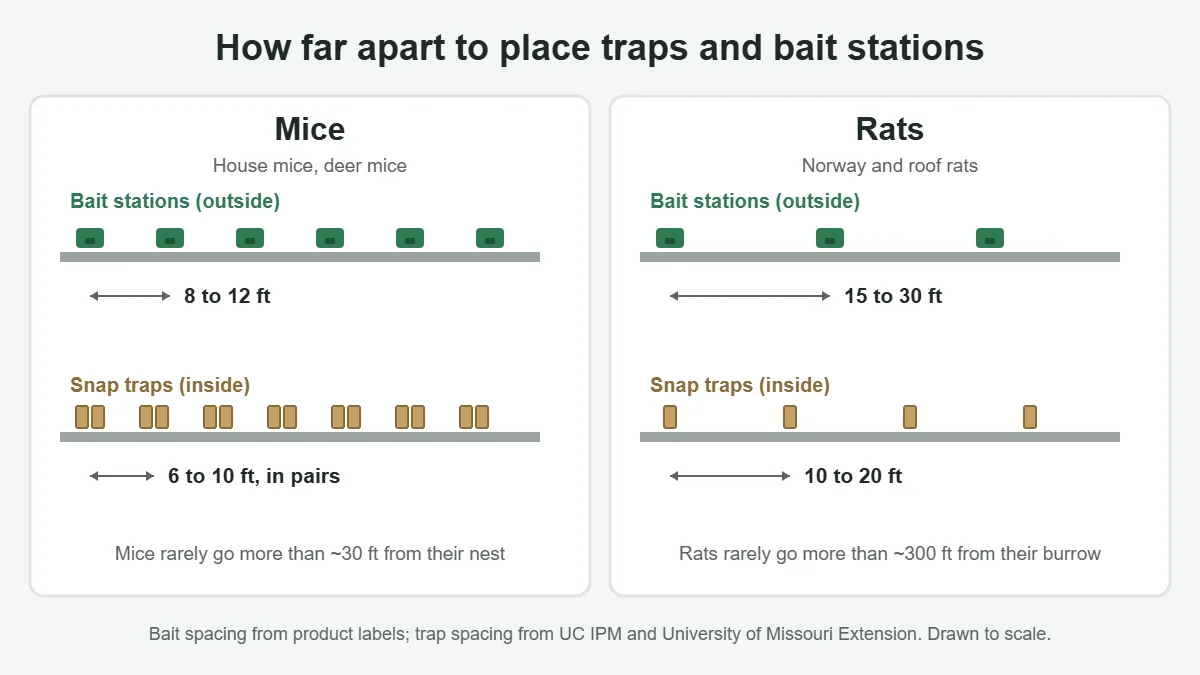
For mice, space bait stations 8 to 12 feet apart and snap traps no more than about 10 feet apart, set in pairs. For rats, space bait stations 15 to 30 feet apart and traps 10 to 20 feet apart. A typical 2,000 sq ft one-story house needs about 11 bait stations for mice or 6 for rats along the sides where you see activity, plus 4 to 8 snap traps in each room with droppings. The calculator below works out the numbers for your home and maps where outdoor stations go.
How Many Traps or Bait Stations Do I Need?
Get a trap and bait station count for your home, the spacing product labels and university guides recommend, and a map of where outdoor stations go. Nothing is stored or sent.
Table of Contents
How many bait stations do I need?
Count the stations from the length of outside wall where rodents are active, divided by the spacing on your product label. Rodenticide labels give the spacing: house mice placements usually 8 to 12 feet apart, rats 15 to 30 feet apart (EPA-registered label, Maki bait packs). Use the tight end of the range when activity is heavy and the wide end for a light problem.
Most homes don’t need stations around the whole house. Labels tell you to place bait “in infested areas,” so start with the walls where you find droppings, gnawing, burrows or rub marks. These counts assume moderate activity (10 ft spacing for mice, 20 ft for rats):
| Home (one story) | Outside wall | Mice: half the house | Mice: all around | Rats: half the house | Rats: all around |
|---|---|---|---|---|---|
| 1,500 sq ft | about 180 ft | 9 | 18 | 5 | 9 |
| 2,000 sq ft | about 205 ft | 11 | 21 | 6 | 11 |
| 3,000 sq ft | about 250 ft | 13 | 25 | 7 | 13 |
Two-story homes have a smaller footprint, so they need fewer outdoor stations than a one-story house of the same size. Indoors, use traps for mice: University of California experts advise against poison baits inside because mice can die in hidden places and cause odors (UC IPM Quick Tips).
How many bait stations do I need for rats?
For rats, plan one station every 15 to 30 feet along the walls, fences or runways where rats travel. A light problem on one side of a house may need only 2 or 3 stations; heavy activity all around a 2,000 sq ft home needs about 14 at 15 ft spacing.
Expect a delay before rats feed. Rats often avoid new objects, and Norway rats may take anywhere from a few days to a few months to enter newly placed stations (PCT). Adding more stations does not speed that up. Putting them on the paths rats already use does.
How far apart should bait stations be placed?
| Mice | Rats | |
|---|---|---|
| Bait stations | 8 to 12 ft apart | 15 to 30 ft apart |
| Snap traps | No more than 10 ft apart; 6 ft for heavy activity; in pairs | 10 to 20 ft apart |
| Usual travel range | Seldom more than 30 ft from the nest | Seldom more than 300 ft from the burrow |
| Keep fresh bait out | At least 15 days | At least 10 days |
The spacing follows how far each animal travels. UC IPM notes that house mice seldom venture more than 30 feet from their nest and food, so traps should go no more than about 10 feet apart where mice are active (UC IPM House Mouse). University of Missouri Extension recommends rat traps about 10 to 20 feet apart and notes rats seldom travel farther than 300 feet from their burrows (MU Extension G9446). Bait durations come from product labels, which say to keep fresh bait available for 15 days for mice and 10 days for rats, or until feeding stops.
Where to put bait stations
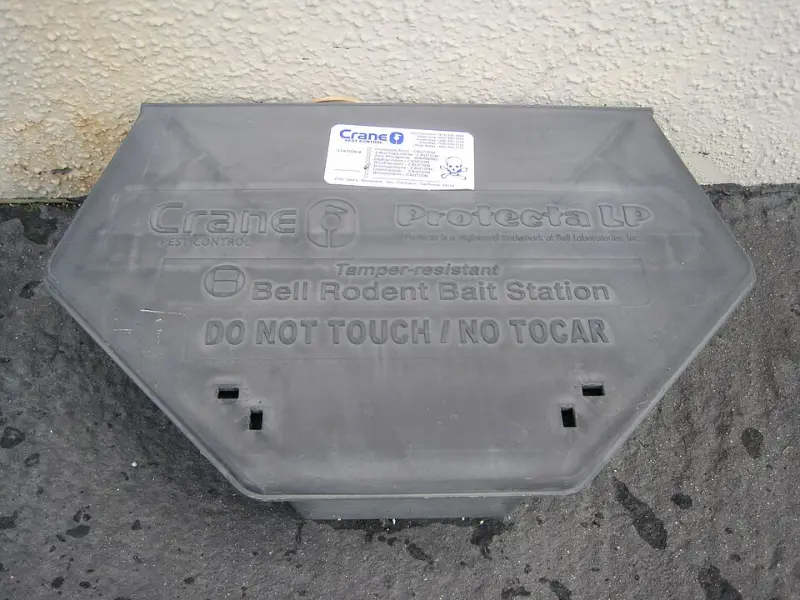
- Against the wall. Rats and mice run along walls and edges. Set stations flat against the foundation with the openings parallel to the wall.
- On runways and near droppings. Place stations where you see droppings, gnaw marks, rub marks or burrows, in corners and under cover such as shrubs or decks (PCT).
- Within 50 feet of the building. Household bait stations used outdoors must be the weather-resistant, tamper-resistant kind, and they may be used within 50 feet of buildings (EPA).
- Away from children and pets. Anchor stations so they can’t be carried off, and keep them out of play areas. See rat poison safety before you buy.
How many traps do I need?
Use more traps than seems necessary and catch the population quickly. For mice, set traps in pairs along each wall with droppings: 4 traps in a room with light activity, 8 with moderate activity and up to 14 where mice are seen in daylight. The National Park Service suggests ten traps per 12 x 12 ft space or more for heavy infestations (NPS).
For rats, 2 traps per room or runway is a starting point, 4 for heavy activity. Leave rat traps baited but unset for a few days so the rats get used to them, then set them all on the same night (California DPR). Our mouse trap comparison covers which traps work best.
Do rat bait stations attract more rats?
Bait stations don’t pull rats in from far away. Rats find stations while moving through the area they already use, which is why labels tell you to place bait where rats are active. Rats that live within a few hundred feet, including next door, may find and feed from your stations, and that removes them too.
Food, water and shelter are what draw rats to a property: pet food, bird seed, fallen fruit, garbage, woodpiles and dense plants against the house. Clearing those, and sealing gaps in the house, does more to keep new rats away than adding or removing stations. Once activity stops and bait is no longer being eaten, remove the poison and keep an eye out for new signs.
How long to leave bait stations out
Check stations every few days at first and replace eaten bait. Labels call for an uninterrupted supply of fresh bait for at least 15 days for mice or 10 days for rats, or until there are no more signs of feeding. If bait sits untouched for weeks, the stations are in the wrong place or the rodents have food elsewhere. Move the stations to where you find fresh droppings.
Related guides
- How to get rid of mice
- How to get rid of rats
- Mouse droppings vs rat droppings
- Rat poison: types, safety and pets
Sources
- Liphatech. Maki Rat and Mouse Bait Packs, EPA Reg. No. 7173-188, label.
- Quinn N., Frye M. Pest Notes: House Mouse. UC IPM, revised July 2025.
- UC IPM. Quick Tips: House Mouse.
- Pierce R.A. Controlling Rats (G9446). University of Missouri Extension.
- U.S. EPA. Restrictions on Rodenticide Products.
- California Department of Pesticide Regulation. Trapping Commensal Rodents.
- National Park Service. Proper Use and Placement of Snap Traps.
- PCT Magazine. Bait Station Reactions.