
The western conifer seed bug is a large, brown leaf-footed bug about 3/4 inch long, with flattened, leaf-like hind legs and a faint white zigzag across its back. When it flies it buzzes loudly and flashes an orange-yellow abdomen. It feeds on pine cones outdoors and slips into houses from September to November to spend the winter. It doesn’t bite, breed indoors or damage anything. Remove the ones inside by hand or vacuum, and seal gaps around windows, doors and soffits to keep more out.
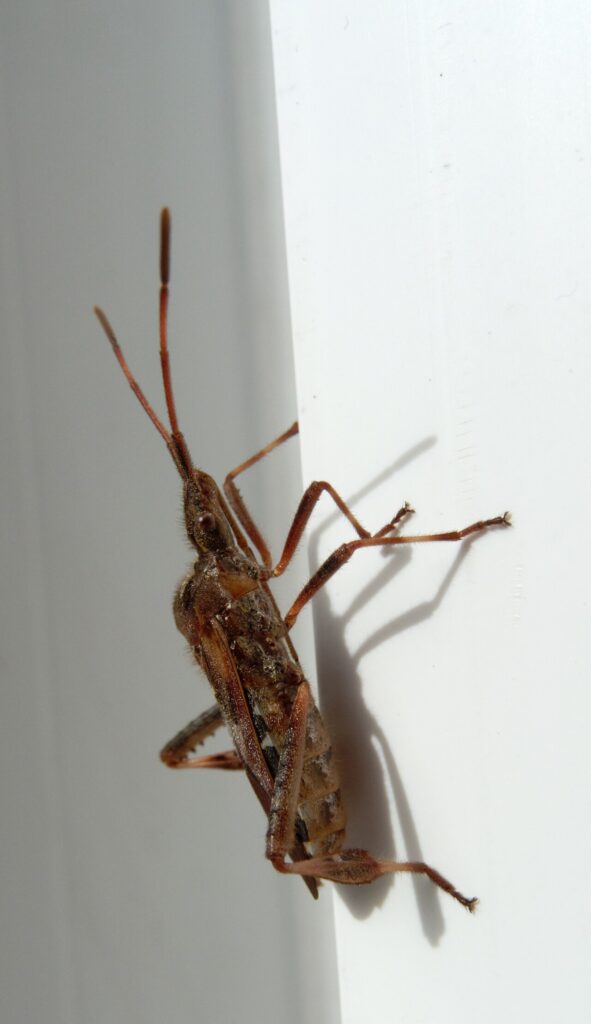
Table of Contents
How to Identify a Western Conifer Seed Bug
- Size: about 3/4 inch long, with a narrow, elongated body.
- Color: reddish-brown to dull brown.
- Back: a thin white zigzag band across the middle of the wings, sometimes faint or missing. The dark wing tips form a diamond at the rear.
- Hind legs: the lower part of each hind leg is flattened into a leaf-like shape, the key feature.
- Antennae: long, with four segments.
- In flight: loud buzzing that sounds like a bee, showing an orange-yellow abdomen with black bands.
Western Conifer Seed Bug Look-Alikes
| Bug | How to tell it apart |
|---|---|
| Stink bug | Wide, shield-shaped body and no leaf-like legs. See stink bug pictures. |
| Squash bug | Similar shape and color but no flattened hind legs; lives on squash and pumpkin plants and rarely enters homes. |
| Kissing bug | Thin, cone-shaped head and thin legs with no flat parts; feeds on blood and can carry Chagas disease. Rare indoors in northern states. |
| Assassin bug | No broad hind legs, a curved beak, and can give a painful bite if handled. |
| Boxelder bug | Smaller, black with red lines. See boxelder bugs. |
Where Western Conifer Seed Bugs Come From
As the name says, the bug is native to the western United States. It started spreading east in the 1950s, reached Pennsylvania by 1992 and is now found across the U.S. and southern Canada. It has also spread to Europe, Japan and other parts of the world.
Outdoors, it feeds on the sap of developing cones and seeds of pines, Douglas-fir, spruce and hemlock. The feeding doesn’t harm the health of trees, though it can ruin much of the seed crop in commercial seed orchards.
Life cycle
Females lay small eggs in chains on conifer needles in late spring. The eggs hatch in about 10 days, and the young go through five nymph stages over the summer, feeding on cones and seeds. New adults appear by late summer. There is one generation a year in North America.
Why They Come Into Your House
From September through November, adults look for a sheltered place to spend the winter. They gather on sunny, south-facing walls and crawl in through gaps around siding, windows, doors, soffits, fascia boards and vents. Most people see them one or a few at a time, not in swarms.
They stay dormant in walls and attics and come out on warm winter and early spring days, often at windows and lights. They don’t reproduce, feed or lay eggs indoors.
Do Western Conifer Seed Bugs Bite?
No, for practical purposes. They don’t bite or sting in normal contact. Only one bite has ever been recorded worldwide, which left an itchy red spot. If handled roughly, a bug may try to poke with its beak. They carry no diseases and are harmless to people, pets, the house and its contents.
When disturbed, they release an odor from glands on the thorax that some people describe as pine-like and others as unpleasant. Handle them with a tissue to avoid the smell on your fingers.
How to Get Rid of Western Conifer Seed Bugs
Inside the house
- Pick them up with a tissue and put them outside or drop them in soapy water.
- Vacuum them if there are several, then empty the vacuum outdoors.
- Don’t bother with indoor sprays or foggers. They don’t stop more bugs coming out of the walls.
Keeping them out
- Caulk gaps around window and door frames, soffits, fascia boards, chimneys and where pipes and wires enter.
- Screen attic, soffit and wall vents and chimney openings.
- Repair or tighten loose window screens and add door sweeps.
- Do this in late summer, before September, when the bugs start looking for shelter.
Outdoor insecticide treatments are usually unnecessary and spraying in winter or spring does little. Sealing in late summer also blocks other fall invaders such as Asian lady beetles, stink bugs and cluster flies.
Keep seed bugs out
- Exterior caulk for gaps around windows and soffits
- Window screen repair kit for torn screens
- Door sweeps for exterior doors
- Handheld vacuum for bugs at windows
As an Amazon Associate, Pestbugs earns from qualifying purchases.
FAQs
A large, brown leaf-footed bug, about 3/4 inch long, with flattened, leaf-like hind legs and a faint white zigzag across its back. It feeds on the sap of pine and other conifer cones outdoors and wanders into houses in fall to spend the winter.
Practically never. They don’t bite or sting in normal contact, and only one bite has ever been recorded worldwide. If handled roughly one may try to poke with its beak, but they are harmless to people and pets.
No. They are leaf-footed bugs, a different family, though they give off a pine-like or unpleasant smell when disturbed. Stink bugs are shield-shaped and lack the leaf-like hind legs.
Look at the hind legs and head. Western conifer seed bugs have flattened, leaf-like hind legs and a buzzing flight that shows an orange-yellow abdomen. Kissing bugs have a thin, cone-shaped head and thin legs with no flat parts, feed on blood and rarely come indoors in northern states.
In September through November they look for a sheltered place to overwinter. They gather on sunny south-facing walls and crawl in around windows, doors, siding, soffits and vents. On warm winter and spring days they wake up and appear in living areas.
Pick them up with a tissue or vacuum them and put them outside or in soapy water. Keep them out by caulking gaps around windows, doors, soffits and utility lines, and by screening vents. Indoor insecticides aren’t needed.
Sources
- Penn State Extension: Western Conifer Seed Bug
- University of Minnesota Extension: Western Conifer Seed Bug and Hackberry Psyllids
- Iowa State University Extension: Western Conifer Seed Bug
- University of Wisconsin Extension: Western Conifer Seed Bug
- Ohio State University BYGL: Western Conifer Seed Bugs Don’t Kiss People
- Colorado State University: Western Conifer Seed Bug
Facts in this guide are checked against the sources above and reviewed when they change. See how we research in our editorial policy.