
Cluster flies are slightly larger than house flies, dull gray with golden hairs on the thorax, and fold their wings over each other at rest. House flies are smaller, with four dark stripes on the thorax and wings held slightly apart. Behavior is the easier tell: cluster flies are slow and gather at sunny windows in fall and winter after sheltering in your walls, while house flies are quick, buzz around food and garbage in summer and breed in waste. House flies can spread germs; cluster flies are only a nuisance.
Table of Contents
Cluster Fly vs House Fly at a Glance
| Cluster fly | House fly | |
|---|---|---|
| Size | About 3/8 to 1/2 inch | About 1/4 inch |
| Color | Dull gray or gray-brown, often with light patches on the abdomen | Gray |
| Thorax | Short golden-yellow hairs | Four dark lengthwise stripes |
| Wings at rest | Flat over the back, tips overlapping | Held slightly apart |
| Flight | Slow, clumsy, easy to swat | Fast and agile |
| Season indoors | Fall through early spring, at windows | Mostly summer, around food |
| Where they breed | Inside earthworms in soil outdoors | Garbage, manure, pet waste, rotting food |
| Eat your food? | No | Yes; land on food, spit and leave fecal spots |
| Spread disease? | Not known to | Can carry Salmonella, E. coli, Shigella and others |
| Attracted to baits and fly paper? | No | Yes |
How to Tell Them Apart by Looks
Cluster fly
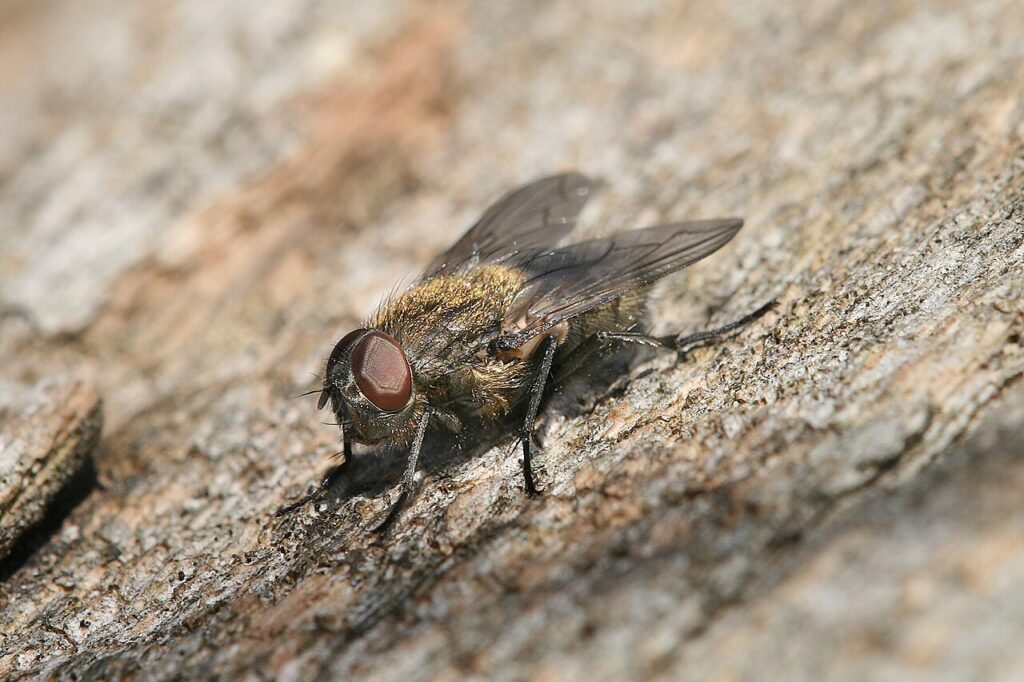
- Slightly larger than a house fly, about 3/8 to 1/2 inch.
- Dull gray to gray-brown, often with lighter patches on the abdomen.
- Short, crinkly golden-yellow hairs on the thorax, most visible near the wing bases and underneath. A hand lens helps.
- Wings lie flat over the back with the tips overlapping, so a resting fly looks narrow.
House fly
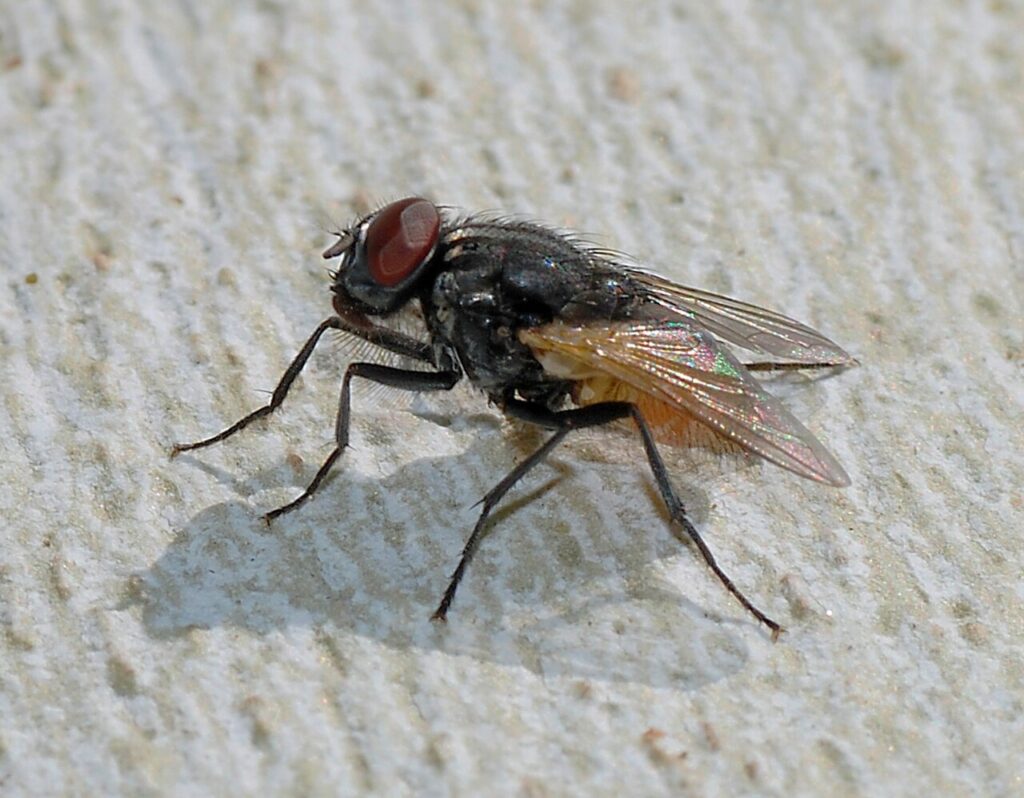
- About 1/4 inch long; females are usually larger than males.
- Gray, with four dark stripes running lengthwise down the thorax.
- Large reddish eyes.
- Wings held slightly apart at rest, giving a V-shaped look from above.
How to Tell Them Apart by Behavior
Cluster flies are sluggish. They crawl out of gaps around window frames, baseboards and light fixtures on warm winter days, buzz in slow circles at sunny windows and are easy to swat. They often appear in rooms nobody uses, like spare bedrooms and attics, and can show up in large groups. Crushed cluster flies smell sweet, like buckwheat honey.
House flies are quick and hard to swat. They come in through open doors and torn screens, are drawn to food, sweat and garbage, and land on kitchen counters and plates. They are inactive at night and most numerous in the hot summer months.
Life Cycle and Where They Come From
Cluster flies develop outdoors. Females lay eggs in soil cracks, and the larvae live inside earthworms for two to three weeks before pupating in the soil. Egg to adult takes about four to six weeks, with three or four generations a year. The last generation spends the winter in buildings and leaves in spring. They never breed indoors.
House flies breed in moist, rotting organic matter: garbage, manure, pet waste, grass clippings and spoiled food. A female lays up to about 500 eggs in batches of 75 to 150. In warm weather they go from egg to adult in as little as 7 to 10 days, and there can be 10 or more generations a year. Adults usually live two to four weeks. House flies indoors almost always came in from outside.
Which One Is Harmful?
Cluster flies don’t bite, don’t feed on your food and aren’t known to carry disease. Their only harms are nuisance, droppings spots on windows, and dead flies in walls that can attract carpet beetles.
House flies are a real hygiene problem. They pick up bacteria, viruses and parasites from garbage and feces on their feet, mouthparts and bodies and leave them on food. They have been linked to diarrheal illness and food poisoning, with germs such as Salmonella, Shigella, Campylobacter and E. coli. Neither fly bites people.
Control Is Different for Each
Getting rid of cluster flies
- Vacuum flies at windows.
- Seal gaps inside around trim, outlets and light fixtures, and outside before late August.
- Use UV light traps in attics and unused rooms; see cluster fly traps and sprays.
- Don’t bother with baits or fly paper, and don’t spray wall voids.
Full plan: how to get rid of cluster flies.
Getting rid of house flies
- Remove breeding spots: bag garbage, keep tight lids on bins, empty them at least weekly and keep them away from doors.
- Pick up pet waste and clean up spilled food and rotting produce.
- Repair screens and keep doors closed.
- Use bait traps outdoors away from doors, sticky paper for a few flies in a small space, and light traps indoors away from windows.
- Pesticides are rarely needed in homes, and house flies have become resistant to many of them.
Fly control supplies
- UV light trap with glue boards for cluster flies in attics
- Outdoor fly bait trap for house flies
- Trash cans with tight lids to cut house fly breeding
- Window screen repair kit to keep house flies out
As an Amazon Associate, Pestbugs earns from qualifying purchases.
FAQs
Cluster flies are slightly larger, dull gray with golden hairs on the thorax, fold their wings over each other at rest and fly slowly. House flies are smaller, gray with four dark stripes on the thorax, hold their wings slightly apart and are quick. Cluster flies show up at windows in fall and winter; house flies are a summer pest around food and garbage.
No. Cluster flies are a nuisance but don’t breed indoors, feed on your food or spread disease. House flies breed in garbage and manure and can carry bacteria such as Salmonella and E. coli onto food.
Flies in a house in winter, especially slow ones at sunny windows in little-used rooms, are almost always cluster flies that spent the season in your walls or attic. House flies are rarely active in large numbers in winter.
No. Cluster fly larvae develop inside earthworms in soil outdoors. House flies, by contrast, can lay eggs in garbage, pet waste or rotting food inside or near the house.
For house flies, remove what they breed in: bag garbage, keep lids on bins, clean up pet waste and use screens, bait traps and sticky paper. For cluster flies, vacuum them, seal gaps and use light traps in the attic; baits and fly paper don’t attract them.
Adult house flies usually live about two to four weeks, up to two months. In warm weather they go from egg to adult in as little as 7 to 10 days, so numbers build quickly in summer.
Sources
- Penn State Extension: Cluster Flies
- Purdue Extension: Nuisance Flies, Cluster and Face Flies (E-235)
- Colorado State University Extension: Cluster Flies and Other Winter Flies
- University of Florida IFAS: House Fly, Musca domestica (EENY-048)
- UC IPM Pest Notes: Flies
- University of Minnesota Extension: Flies
- University of Kentucky Entomology: Cluster Flies, Face Flies and Blow Flies in Homes
Facts in this guide are checked against the sources above and reviewed when they change. See how we research in our editorial policy.