
Peppermint oil does not reliably keep mice away. In a 2022 laboratory study, house mice avoided areas sprayed with peppermint oil right after spraying, but showed no repellent effect a week later. A 2016 scientific review of plant-based rodent repellents found results inconsistent between lab and field tests. Peppermint oil may discourage mice briefly, but it won’t remove mice already living in your home. Sealing entry holes and trapping are what work.

Table of Contents
What the Research Shows
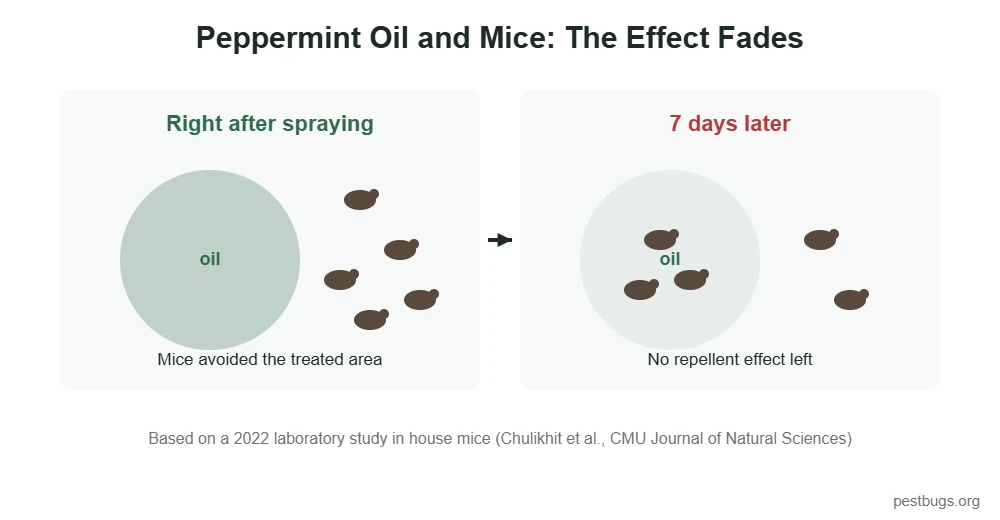
The evidence on peppermint oil and mice is thin. The clearest test is a 2022 study in house mice that sprayed peppermint oil on fabric in a maze. Right after spraying, mice took longer to enter and spent less time in the treated areas. One week later, peppermint oil had no significant repellent effect.
A 2016 systematic review of 54 studies on plant compounds as rodent repellents found that essential oils showed some of the strongest effects in the lab, but success was inconsistent across laboratory, enclosure and field studies. In a real house, mice are hungry, have nests and young, and get used to smells over time. Wildlife experts note that animals tend to get used to deterrents, and ignore them when they badly need the food or shelter being protected.
Why Peppermint Oil Products Aren’t Proven
Many store-bought “mouse repellent” sprays and pouches use peppermint oil. Peppermint oil is on the EPA’s list of ingredients allowed in minimum risk pesticides, which are exempt from federal registration. That means the EPA does not review these products to check whether they actually work. A label that says “repels mice” has not been proven to the EPA.
How to Use Peppermint Oil If You Still Want to Try It
- Use it as an add-on, not the main plan. Seal holes and set traps at the same time.
- Put a few drops on cotton balls and place them near entry points, in cabinets and in the garage, out of reach of children and pets.
- Refresh every few days, because the smell fades quickly.
- Concentrated essential oils can harm pets, especially cats, so keep them away from where pets eat, sleep or groom. See why essential oils are risky for cats.
Other Mouse Repellents: Do They Work?
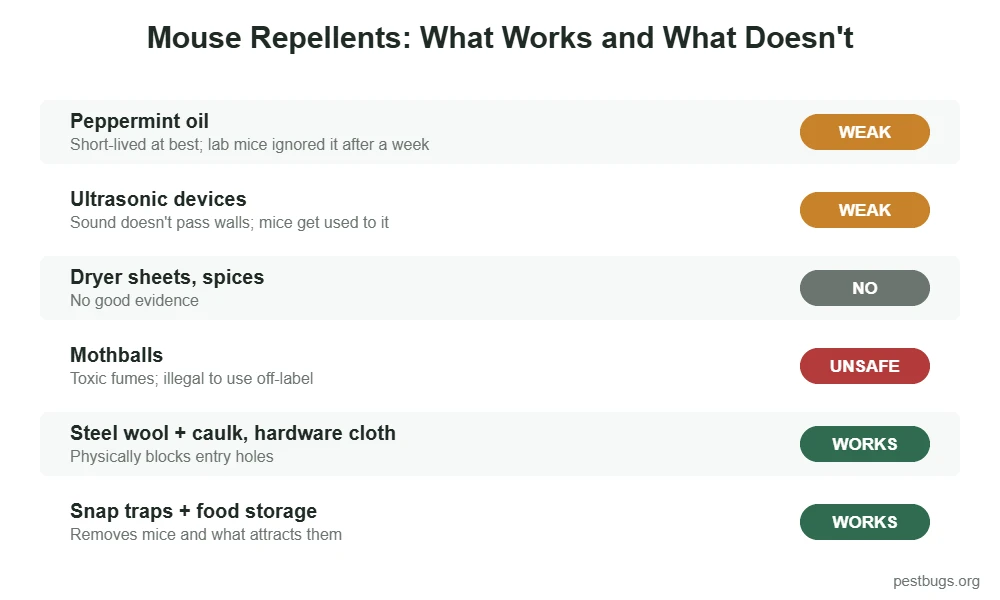
- Ultrasonic devices: the sound doesn’t pass through walls or furniture, and mice get used to it within days. Extension services don’t recommend them.
- Dryer sheets, cloves, cayenne and other home remedies: there is no good evidence they keep mice out.
- Mothballs: don’t use them as a mouse repellent. Their fumes are toxic, and using a pesticide in a way its label doesn’t allow, such as scattering mothballs in an attic or yard, is illegal.
- Steel wool and caulk: these work, not because mice dislike them, but because they physically block holes. Pack steel wool into gaps and seal it with caulk, or cover larger openings with 1/4-inch hardware cloth.
- Cats: a cat may catch some mice but rarely ends an infestation.
Peppermint and other essential oils are also sold for bed bugs and fleas, with little better evidence.
What Actually Keeps Mice Away
- Seal entry points: close every gap wider than 1/4 inch with steel wool and caulk, hardware cloth, sheet metal or cement.
- Remove food: store food, pet food and birdseed in glass or metal containers with tight lids.
- Trap the mice already inside: set snap traps along the walls where you see droppings. See the best mouse traps compared.
- Recheck each fall, when mice look for warm places to spend the winter.
Full step-by-step guide: how to get rid of mice in your house.
Supplies that keep mice out
- Coarse steel wool for small gaps
- 1/4-inch hardware cloth for vents and larger gaps
- Rodent-proof door sweep
- Snap traps
- Peppermint oil (optional add-on only)
As an Amazon Associate, Pestbugs earns from qualifying purchases.
FAQ
Not reliably. In a lab study, mice avoided peppermint oil right after spraying, but the effect was gone after a week. It won’t remove mice already living in your home.
Only a few days at most, because the smell fades. In one study, there was no repellent effect after seven days.
No smell has been proven to keep mice out of a home for long. Peppermint oil, ammonia and other strong smells may deter them briefly, but mice get used to them.
Concentrated essential oils can harm pets, especially cats. Keep cotton balls and sprays out of reach and away from pet food, beds and water.
Seal entry holes with steel wool and caulk or hardware cloth, store food in sealed containers, and trap mice already inside. These steps work better than any smell.
Sources
- Chulikhit et al. (2022): The Repellent Potential of Herbal Oils in Mouse Behavioral Models, CMU Journal of Natural Sciences
- Hansen et al. (2016): Plant Secondary Metabolites as Rodent Repellents, a Systematic Review, Journal of Chemical Ecology
- Cornell University IPM: Minimum Risk Pesticides
- University of Florida IFAS: How to Use Deterrents to Stop Damage Caused by Nuisance Wildlife
- National Pesticide Information Center: Mothball Regulation and Labels
- University of Nebraska Extension: Controlling House Mice (G1105)
- CDC: How to Seal Up to Prevent Rodents