
Roof rats are sleek climbers with a pointed nose, large ears and a tail longer than their body; they nest in trees and attics. Norway rats are larger and stockier, with a blunt nose, small ears and a shorter tail; they dig burrows and live in basements and ground floors. Both are much bigger than mice, whose droppings are only about 1/4 inch long. Knowing which rat you have tells you where to seal and where to set traps: up high for roof rats, along the ground for Norway rats.
Table of Contents
Roof Rat vs Norway Rat at a Glance
| Roof rat | Norway rat | |
|---|---|---|
| Other names | Black rat, ship rat (Rattus rattus) | Brown rat, sewer rat, wharf rat (Rattus norvegicus) |
| Weight | About 5 to 12 ounces | About 7 to 18 ounces |
| Build | Sleek and slender | Large and stocky |
| Nose | Pointed | Blunt |
| Ears | Large; reach the eyes when folded forward | Small; don’t reach the eyes |
| Tail | Longer than head and body, scaly and dark | Shorter than head and body; dark above, pale below |
| Fur | Black, gray or brown, with a gray, white or cream belly | Coarse, brown or reddish-gray with a lighter belly |
| Droppings | About 1/2 inch, pointed at one end, often banana-shaped | About 3/4 inch, capsule-shaped with blunt ends, often clumped |
| Lifestyle | Climbs; nests high | Burrows; nests low |
| Range | Warm and coastal areas; main rat in Florida | Across the U.S.; rare in Florida |
Roof Rats
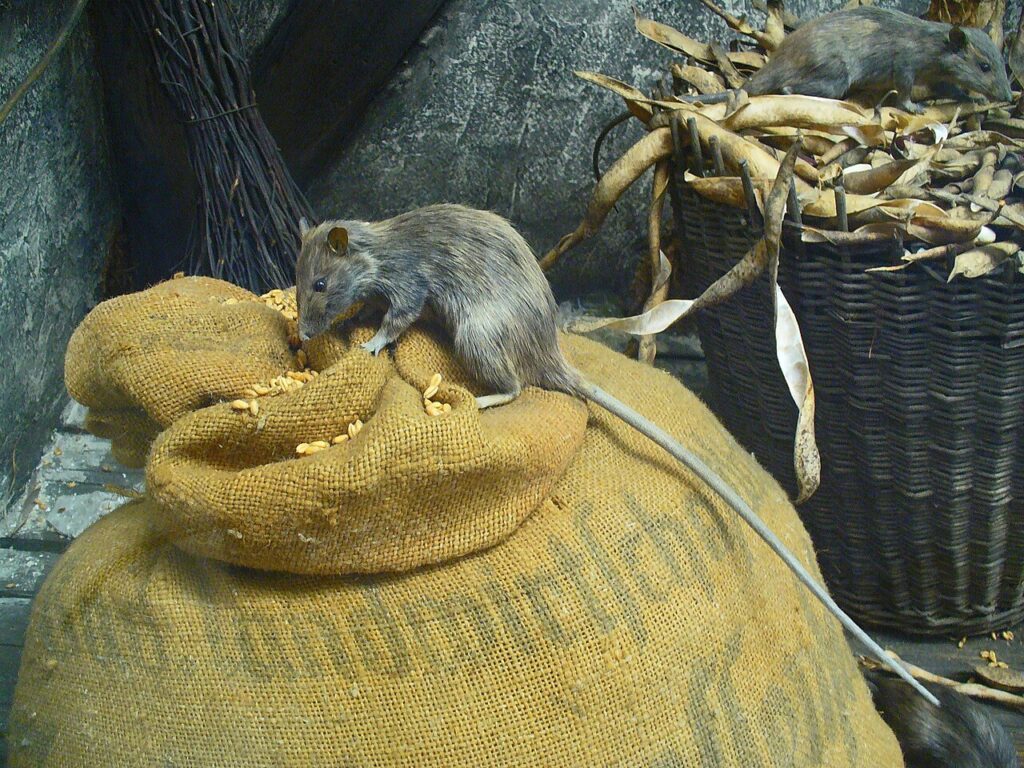
Roof rats are agile climbers that travel along fences, branches, vines and utility lines. Outdoors they nest in trees, palm fronds, ivy and dense shrubs. Indoors they move into attics, wall and ceiling voids, soffits and upper cabinets, which is why scratching overhead is often the first sign. They leave little trace on floors because they travel high.
- Prefer warm and coastal climates; they are the most common rat in Florida.
- Eat fruit, nuts, seeds and pet food, and hollow out citrus and avocados on the tree, often through a quarter-sized hole.
- Have three to five litters a year of five to eight young, maturing at three to four months.
- Are especially wary of new objects, so traps may be avoided for days.
Norway Rats
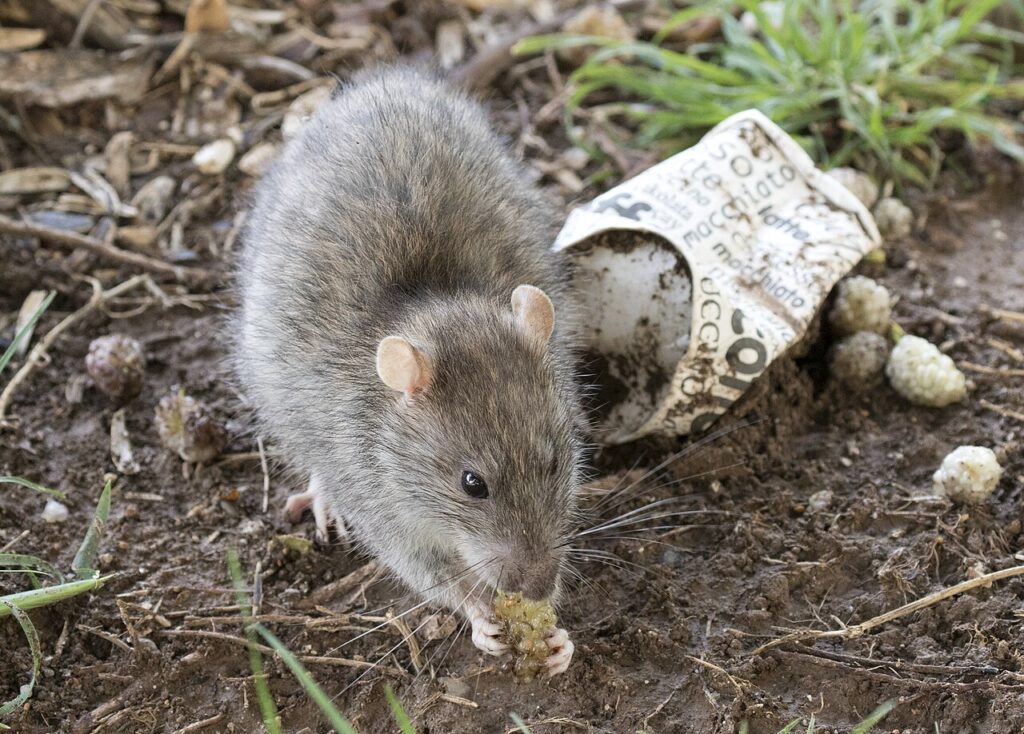
Norway rats are heavy-bodied burrowers. They dig holes 2 to 3 inches across along foundations, under slabs, sheds, woodpiles, compost piles and garbage bins, with smooth, debris-free entrances and usually more than one exit. Indoors they live mostly in basements, crawl spaces and on ground floors, though they can climb into ceilings.
- Found across the U.S., especially around cities, farms and waterfronts.
- Eat almost anything, including garbage, pet food, grain and meat.
- Have four to six litters a year of 6 to 12 young, which can breed at two to three months old.
- Leave greasy rub marks along walls and pipes and packed runways through grass.
Rats vs Mice
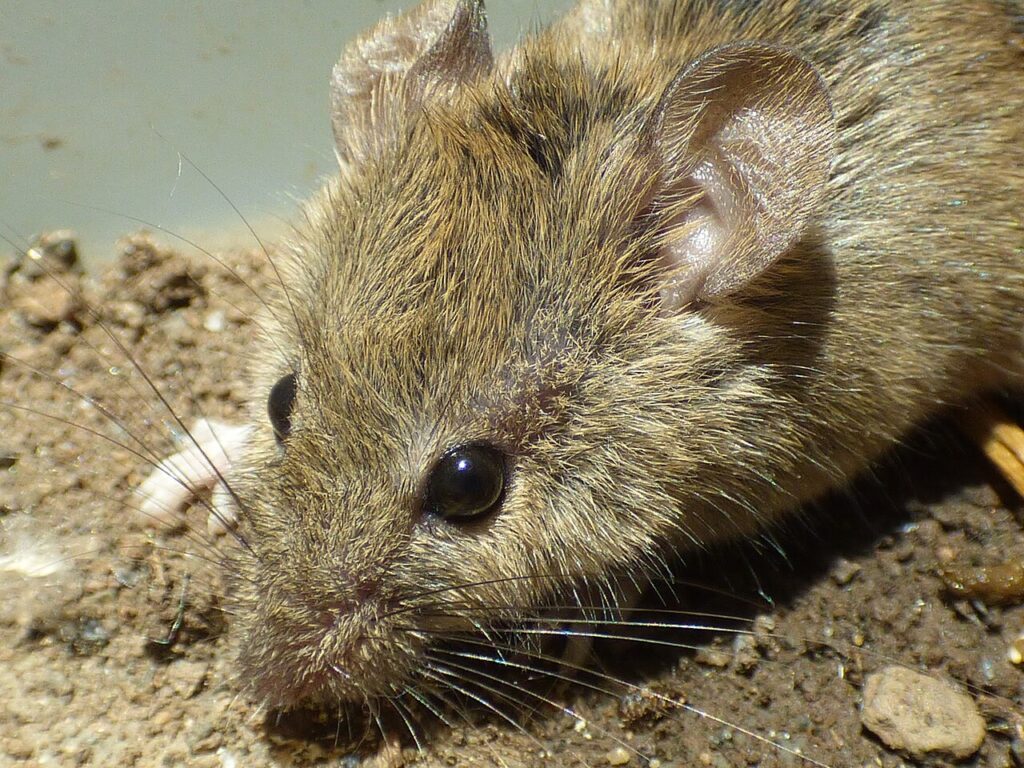
| Rat | House mouse | |
|---|---|---|
| Size | Much larger; about 5 to 18 ounces | Body 2 1/2 to 3 1/2 inches; under 1 ounce |
| Head and feet | Large for the body | Small for the body |
| Droppings | 1/2 to 3/4 inch | 1/8 to 1/4 inch |
| Gnawed holes | About 2 inches, rough edges | About 1 inch, clean edges |
| Gap it can fit through | About 1/2 inch (a quarter) | About 1/4 inch (a pencil) |
| Behavior | Cautious; avoids new objects | Curious; explores new objects |
| Range from nest | Wider | Usually 10 to 30 feet |
Because rats are wary and mice are curious, trapping is different: mice walk into new traps right away, while rats need traps left baited but unset for a few days first. See signs of mice and how to get rid of them.
Why the Difference Matters for Control
Roof rats
- Trim tree branches back 3 to 6 feet from the roof and remove ivy and vines from walls.
- Seal roof vents, soffits, eaves and gaps where utility lines enter, using hardware cloth or sheet metal.
- Set traps up high: on beams, rafters, ledges, shelves, pipes and fence tops, and in the attic.
- Pick up fallen fruit and nuts.
Norway rats
- Seal gaps around the foundation, pipes, doors and basement windows, and repair vent screens.
- Set traps along walls, near burrows and on runways at ground level and in basements.
- Remove woodpiles, debris and dense ground cover next to the house, and keep garbage in metal cans with lids.
Both
- Seal every gap larger than 1/4 inch with metal, hardware cloth or cement; rats chew through plastic, foam and wood.
- Use large rat-size snap traps, pre-bait for a few days, and keep trapping for at least two weeks.
- Avoid glue traps and ultrasonic devices, and use poison only in tamper-resistant bait stations outdoors, if at all.
The full step-by-step plan, plus safe cleanup and disease risks, is in signs of rats and how to get rid of them.
Rat control supplies
- Large rat snap traps for walls and rafters
- 1/4-inch hardware cloth for vents and soffits
- Pole pruner to trim branches back from the roof
- Galvanized trash cans with tight lids
As an Amazon Associate, Pestbugs earns from qualifying purchases.
FAQs
Fold the ear forward and compare the tail. A roof rat’s large ears reach its eyes and its tail is longer than its head and body. A Norway rat’s small ears don’t reach the eyes, its tail is shorter than its body, and it has a blunt nose and stocky build.
Roof rats are climbers. They nest in trees, palms, ivy and dense shrubs outdoors, and in attics, wall and ceiling voids, soffits and upper cabinets indoors. They are most common in warm, coastal areas and are the main rat in Florida.
Norway rats are burrowers. They dig along foundations, under sheds, woodpiles, compost and garbage bins, and indoors live mostly in basements and on ground floors, though they also get into ceilings.
Rats are much bigger, weighing 5 to 18 ounces compared with under an ounce for a mouse, with larger heads and feet. Rat droppings are 1/2 to 3/4 inch long; mouse droppings are 1/8 to 1/4 inch. Mice fit through 1/4-inch gaps, rats through 1/2-inch gaps, and rats are far more cautious around traps.
Yes. Norway rat, brown rat, sewer rat and wharf rat are all names for Rattus norvegicus. The roof rat is also called the black rat or ship rat, even though many roof rats are brown or gray.
The basics are the same: seal gaps, remove food and set large snap traps. Roof rats also need tree branches trimmed back from the roof and traps set up high on beams, ledges and fences. Norway rats are trapped near burrows, along walls and in basements.
Sources
- UC IPM Pest Notes: Rats
- University of Florida IFAS: Roof Rats
- Internet Center for Wildlife Damage Management: Norway Rats
- Internet Center for Wildlife Damage Management: Roof Rat Damage Identification
- University of Kentucky: Rodent Control
- CDC: How to Trap Up to Control Rodents
Facts in this guide are checked against the sources above and reviewed when they change. See how we research in our editorial policy.